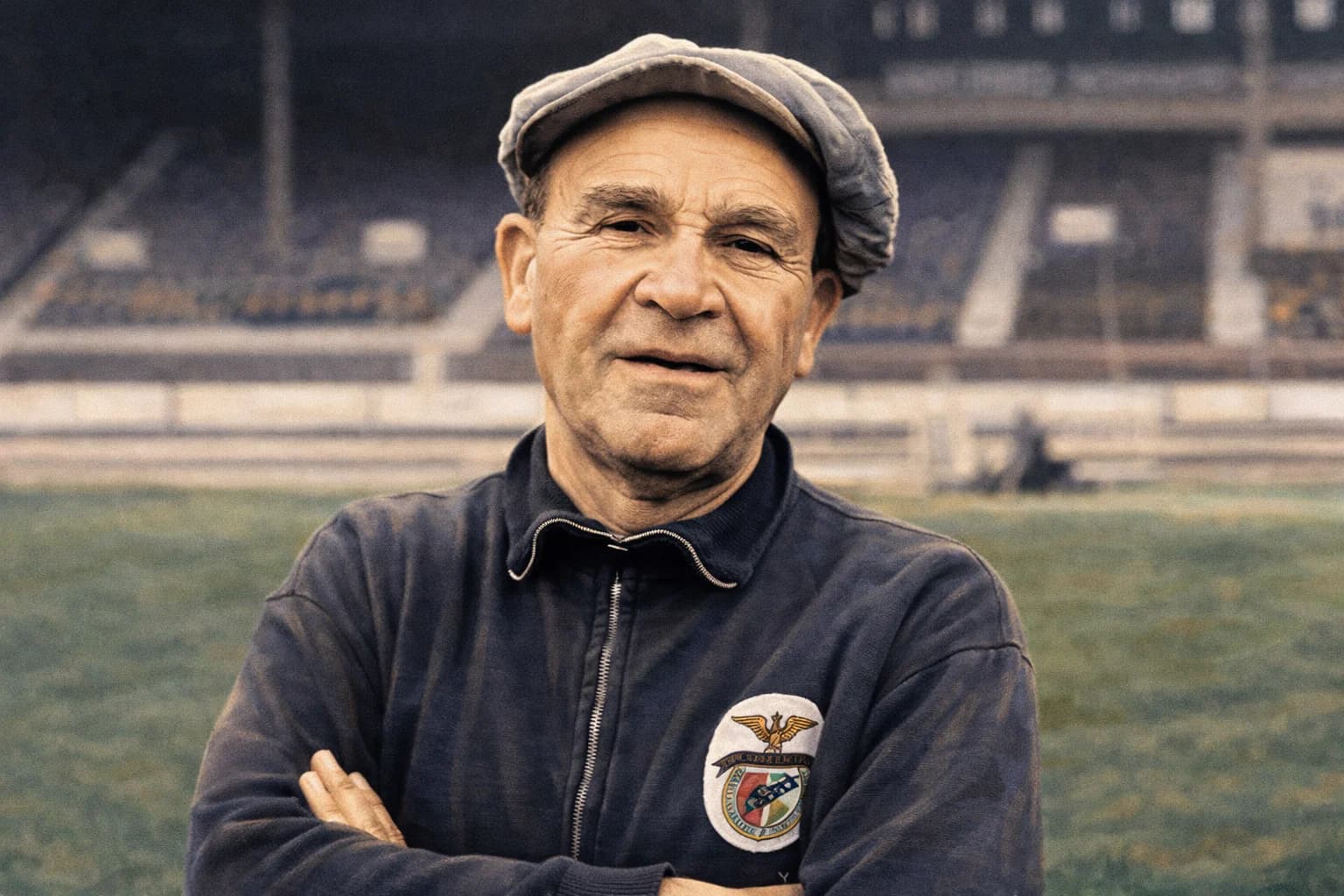
In 1962, Béla Guttmann won Benfica their second consecutive European Cup, asked for a pay rise, and was shown the door. What he said on his way out has haunted the club for over sixty years — and eight lost finals.
Béla Guttmann's Curse: The Man Who Damned Benfica for a Hundred Years
Béla Guttmann won Benfica back-to-back European Cups. He beat Barcelona in the first final, 3-2, after falling behind early. He beat Real Madrid in the second, 5-3, dismantling the club that had won the competition five straight times. He took a twenty-year-old Eusébio and turned him into the most dangerous forward in Europe. He transformed a decent Portuguese side into the best team on the continent.
Then he asked for a pay rise and the board said no.
What happened next is the most consequential sentence ever spoken in football. And the thing that makes the story strange isn't that Guttmann said it — it's that, sixty-four years later, it still hasn't been broken.
The Survivor
Guttmann was born in Budapest in 1899. He was Jewish, a decent professional footballer in the 1920s, and an early tactical innovator. None of that mattered when the war came. He survived the Holocaust — reportedly escaping from a forced labour camp — and emerged into post-war Europe with nothing except an obsessive understanding of football and a personality that most people found impossible.
He was brilliant. Everyone agreed on that. He was also abrasive, vain, restless, and incapable of staying anywhere longer than two seasons. He managed in Hungary, Italy, Argentina, Brazil, Portugal, Uruguay, Austria, and the Netherlands. He lasted at most clubs long enough to make everyone uncomfortable. His record at São Paulo was outstanding. He left after a year. His stint at AC Milan was brief and chaotic. He moved on.
By 1959, he had landed at Benfica.
The Revolution
Portuguese football in 1959 was competent but modest. Benfica had domestic trophies but no European pedigree. The European Cup was still young — Real Madrid had won all five editions, and the assumption was that Spanish football, or perhaps Italian, would continue to dominate.
Guttmann changed things quickly. He restructured the squad. He built the team around Mário Coluna, the Mozambican midfielder whose passing could unlock any defence. He demanded a 4-2-4 formation — attacking, direct, fast. He alienated half the squad and energised the other half. The players who thrived under him described a man who could make football click — who could explain what everyone else was doing wrong in a way that was impossible to argue with. The players who didn't like him used less generous language.
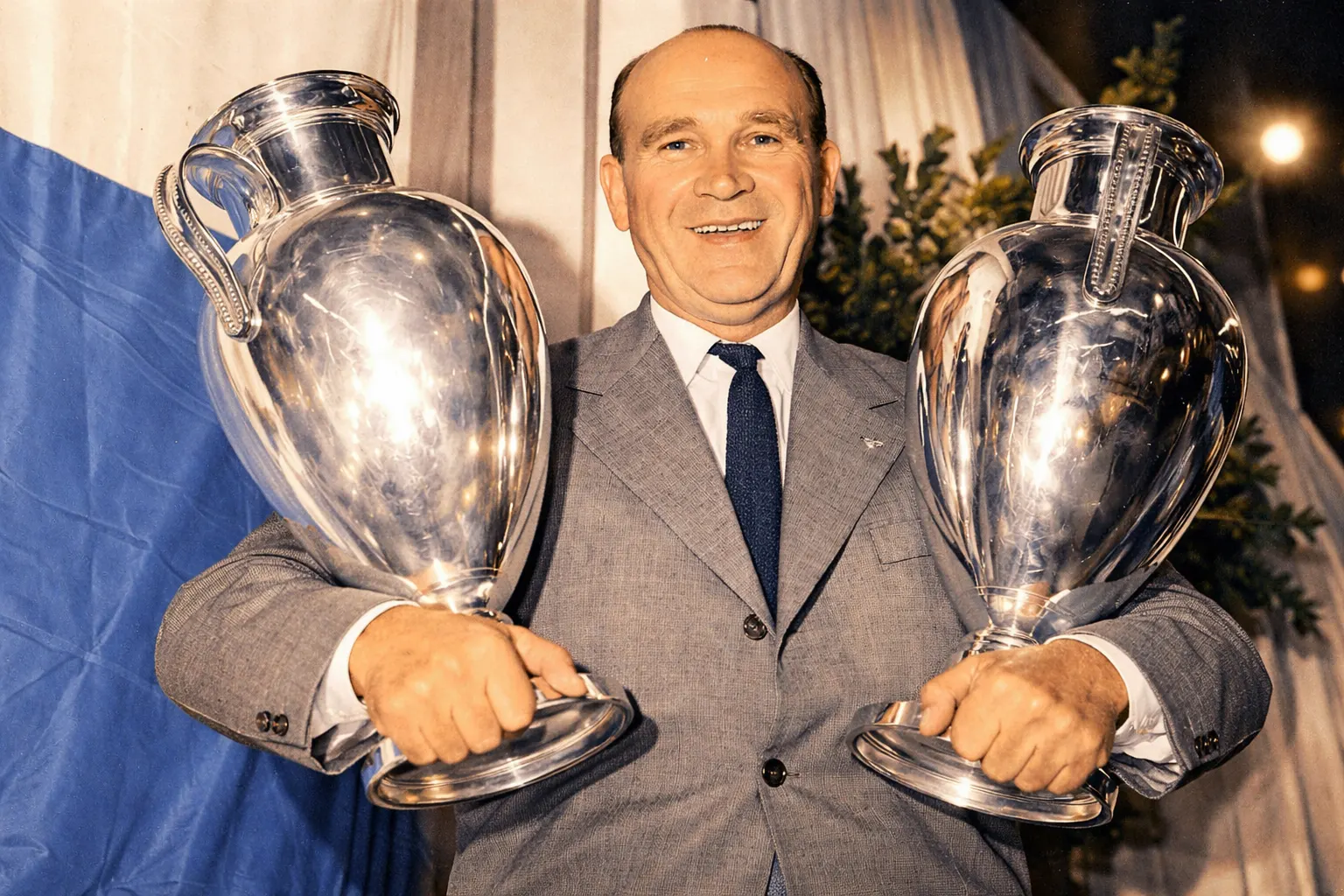 Béla Guttmann with his trophies – brilliant, abrasive, impossible to ignore
In 1961, Benfica reached the European Cup final against Barcelona in Bern. Barcelona were heavy favourites. Sándor Kocsis gave them the lead after twenty-one minutes. What happened next flipped the match in sixty seconds flat.
Águas equalised for Benfica on the half-hour mark. A minute later, Barcelona goalkeeper Antoni Ramallets fumbled a cross into his own net. 2-1 Benfica. Coluna — who had broken his nose in the eighth minute and spent the rest of the match avoiding headers — volleyed in a third from outside the box midway through the second half. Zoltán Czibor pulled one back late, but it wasn't enough. Benfica won 3-2. Nobody outside Portugal had seen it coming.
The Repeat
Benfica were back in the European Cup final a year later. This time the opponents were Real Madrid — five-time winners of the competition, desperate to take back what they considered theirs. They met in Amsterdam, and for the first half hour it was chaos. Ferenc Puskás scored in the 18th minute, then again five minutes later. Águas pulled one back. Cavém equalised. Then Puskás completed his hat-trick in the 39th minute — all three of Real Madrid's goals from one man. The half ended 3-2 to Real Madrid.
Guttmann, the story goes, told his players at half-time that Puskás was finished for the night. He had scored three. He would score no more. They should stop worrying about what had happened and focus on what they were going to do about it. Coluna equalised five minutes after the restart. Then Eusébio, Guttmann's protégé from Mozambique, scored twice in three minutes to seal it. Final score: 5-3.
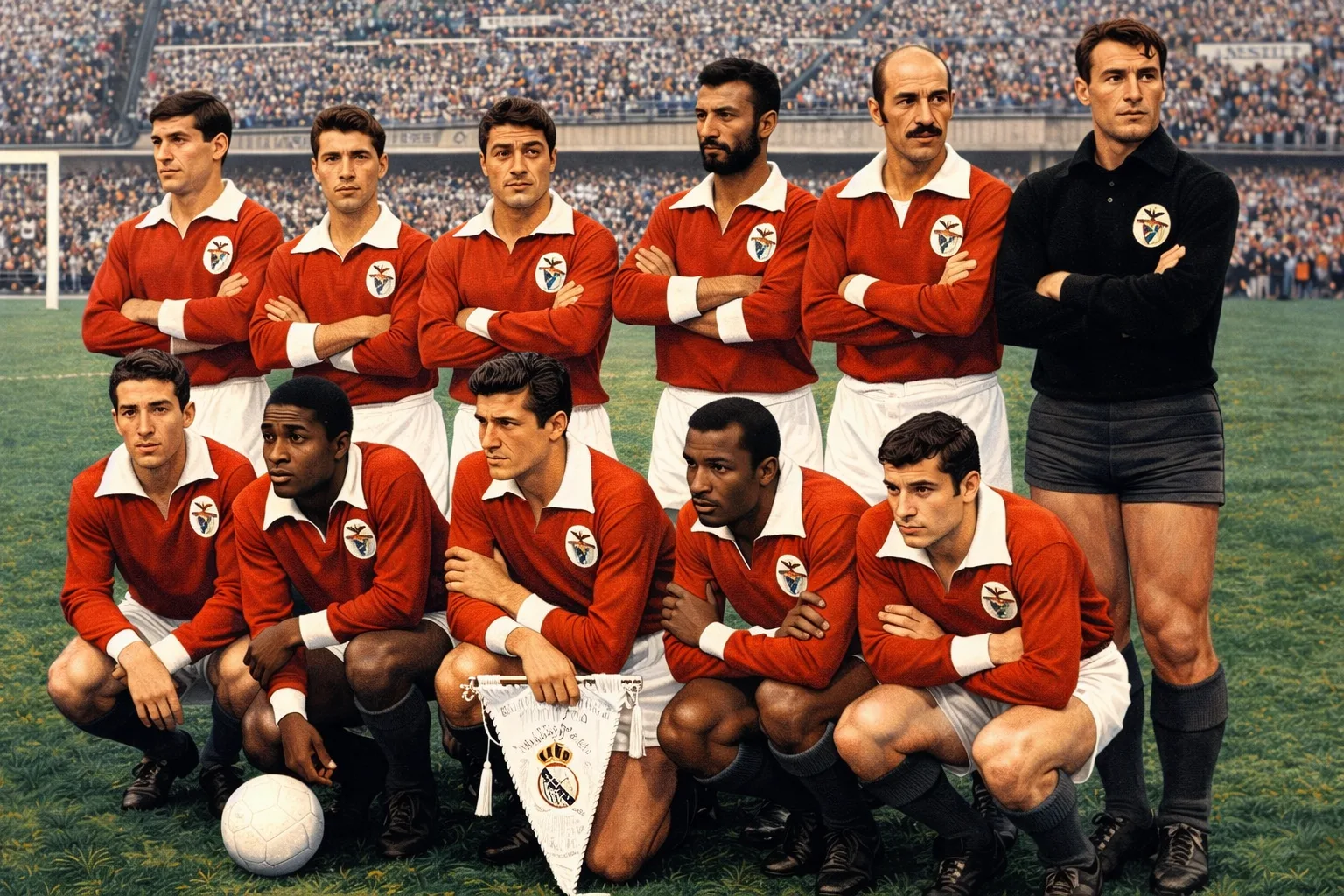 The Benfica squad of 1962 – the last Benfica team to win a European trophy
Two European Cups. Back-to-back. Against Barcelona and Real Madrid. In the space of twelve months, Guttmann had turned a domestic Portuguese club into the best team in Europe.
The Meeting
The exact details of what came next vary depending on who is telling the story. The outline doesn't.
Guttmann went to the Benfica board after the second European Cup and asked for a raise. This was not unreasonable. He had delivered something no Portuguese club had ever achieved. He had done it twice. The board, apparently, felt that coaches were replaceable. Guttmann was told his contract would not be improved.
Some accounts say the discussion was brief. Others say it was ugly. One version has a board member pointing out that Guttmann had been paid according to his contract and should be grateful. This, to a man who had survived a labour camp and built the best team in Europe, did not land well.
Guttmann resigned. On his way out — and again, the exact words vary slightly — he is reported to have said:
"Not in a hundred years from now will Benfica ever be European champion."
That was 1962.
The Evidence
Here is what happened to Benfica in European finals after Guttmann left. All of them lost.
1963 — European Cup final. One year after the curse. Benfica lost to AC Milan, 2-1, at Wembley. Eusébio was still there. Guttmann wasn't.
1965 — European Cup final. Benfica lost to Inter Milan, 1-0, in the San Siro. Helenio Herrera's catenaccio shut them out completely. One goal. Ninety minutes of nothing.
1968 — European Cup final. Benfica lost to Manchester United, 4-1, at Wembley again. With the score at 1-1 and minutes left, Eusébio broke through twice — both times Alex Stepney saved. Eusébio applauded the goalkeeper. The match went to extra time and Matt Busby's team scored three. Eusébio left the pitch in tears.
1983 — UEFA Cup final. Twenty-one years after the curse. Benfica lost to Anderlecht on aggregate. Two legs, no luck.
1988 — European Cup final. Benfica lost to PSV Eindhoven on penalties. They had the better team. They probably should have won. The ball didn't cooperate.
1990 — European Cup final. Benfica lost to AC Milan, 1-0, in Vienna. Milan again. Different decade, same result.
Then a long gap. Twenty-three years without reaching a European final. Some Benfica supporters may have briefly hoped the curse had expired through irrelevance.
2013 — Europa League final. Benfica lost to Chelsea, 2-1, in Amsterdam. Fernando Torres opened the scoring, Oscar Cardozo equalised from the penalty spot. Then, in the third minute of stoppage time, Branislav Ivanović headed in a corner. Benfica had dominated possession. It made no difference.
2014 — Europa League final. Back-to-back again, except this time on the wrong side of it. Benfica lost to Sevilla on penalties. Again.
Eight finals. Eight defeats. Losing eight consecutive European finals is the kind of statistic that would get a probability textbook thrown at a wall.
The Attempts to Break It
Benfica have tried. The club has not treated the curse as a joke — at least not entirely.
In 2013, before the Europa League final against Chelsea, club officials reportedly visited Guttmann's grave in Vienna to ask for forgiveness. They didn't win.
Various Benfica managers over the years have been asked about the curse. Most give diplomatic answers that don't quite commit to calling it nonsense. Jorge Jesus, who managed the team in both the 2013 and 2014 finals, was once asked what he thought. He paused long enough for the pause to count as an answer.
Supporters have organised trips to Guttmann's grave. Flowers have been laid. Rabbis have been consulted. In Portugal, where football and superstition maintain a close working relationship, the curse is discussed in newspapers as though it were a structural issue — something the board needs to address, like stadium maintenance or youth development.
The Clock
Guttmann said a hundred years. He was specific. That means the curse, if one chooses to take it literally, expires in 2062.
Benfica have been one of the strongest Portuguese clubs for every one of those years. They have won dozens of league titles. They have produced extraordinary players — Eusébio, Rui Costa, João Félix, countless others. They have qualified for European competition season after season. They have, on multiple occasions, been good enough to reach finals. They have never, not once since 1962, won one.
The simplest explanation is that finals are hard to win, luck plays a role, and coincidences happen. Eight consecutive final defeats is unusual but not impossible. Teams lose. Penalties miss. Crossbars don't move.
The less simple explanation is that a Hungarian Holocaust survivor who was denied a pay rise after building the greatest team in Portuguese history said something on his way out the door, and it stuck.
Guttmann died in 1981, in Vienna. He was 82. He never managed Benfica again. He never publicly discussed the curse. He didn't need to. By 1981, it had already claimed three European finals. Five more followed.
His grave, in the Döblinger Friedhof cemetery in Vienna, has become something between a shrine and a complaint box. Red scarves are sometimes draped over it. Letters are left. The tone of these letters, according to those who have read them, tends to alternate between respectful and pleading.
Whether you believe in curses or not, the numbers don't argue. Eight finals, zero wins, sixty-four years and counting. As of March 2026, the drought continues — Benfica have not added a single European trophy since that night in Amsterdam in 1962. The hundred-year clock runs until 2062.
Somewhere in Vienna, the headstone doesn't say anything about football.
Sources: Jonathan Wilson's "The Names Heard Long Ago"; Benfica's official club history; Portuguese sports dailies A Bola and Record; Tom Galvin's biography of Guttmann; contemporary match reports from the European Cup finals of 1961, 1962, 1963, 1965, 1968.