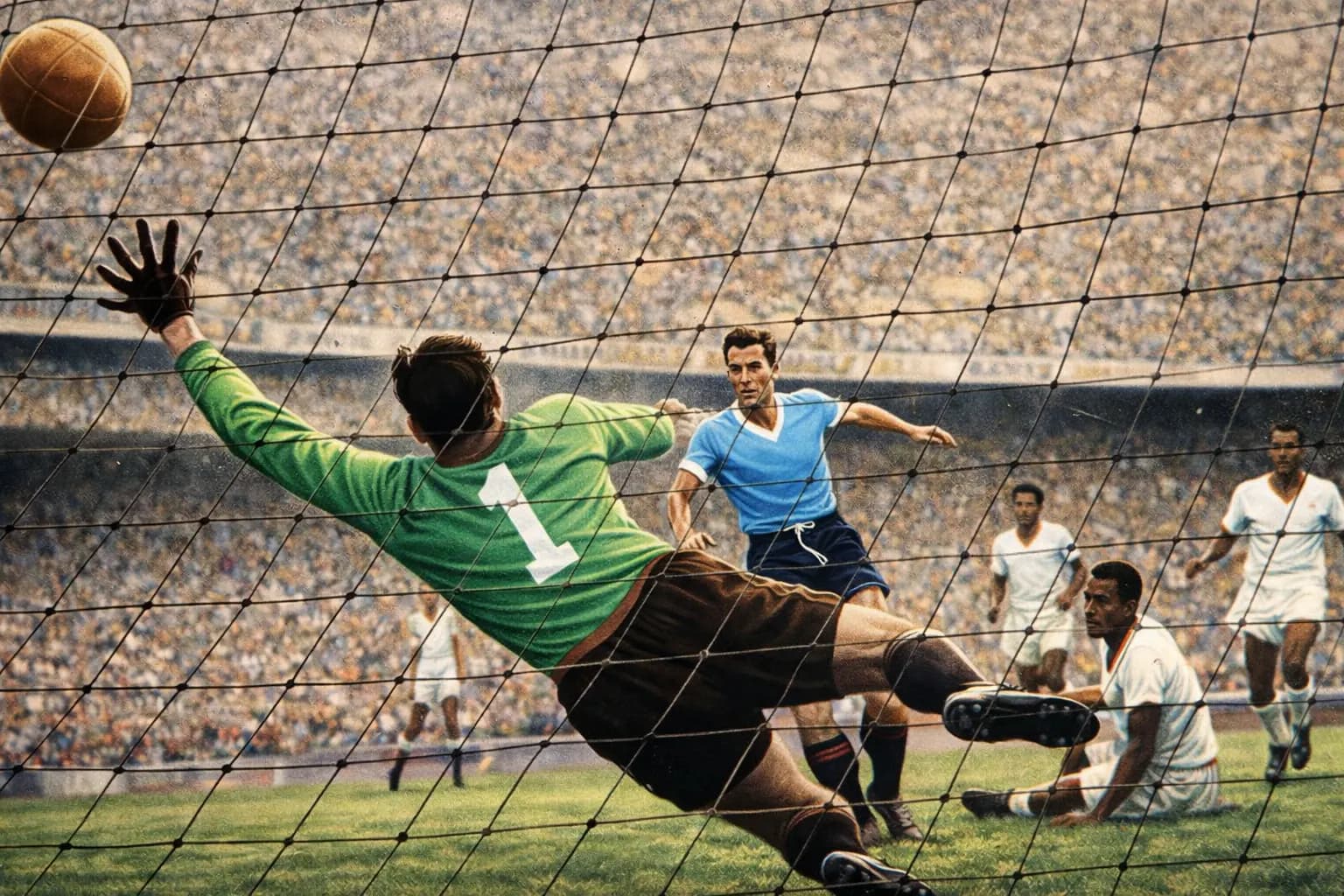
On July 16, 1950, Brazil needed just one point to be crowned world champions in front of the biggest crowd ever assembled for a football match. What happened next would haunt a nation for generations, destroy one man's life, and change Brazilian football forever.
The Maracanazo: How Uruguay Silenced 200,000 People and Broke a Nation
The medals had already been minted. Gold ones, with "Brazil — World Champions" engraved on the back. The city of Rio de Janeiro had the parade route mapped out. Poets had written victory odes. A Rio newspaper ran the headline before kick-off: "These are the world champions." Jules Rimet, the FIFA president who had given his name to the trophy, had already written his congratulations speech in Portuguese — rehearsed, ready to deliver within ninety minutes.
Nobody in Rio that morning was treating it as a question. The question had already been answered.
Here's something worth knowing about how the 1950 World Cup actually worked, because most people don't: there was no final. The tournament ended with a round-robin group of four teams — Brazil, Uruguay, Spain, Sweden — playing each other once. Whoever finished top was world champion. No knockout, no single elimination match. Brazil had already destroyed Sweden 7-1 and Spain 6-1. They entered the last fixture needing only a draw against Uruguay. Not a win. A point would do it. They could have played for a goalless stalemate and lifted the trophy. The mathematics were so comfortable that the celebrations weren't just being planned — they had essentially already happened.
The Stadium Built for a Coronation
The Maracanã had been raised for exactly this. Brazil had lobbied hard to host the 1950 tournament, and the federal government built a stadium to match the ambition — the largest football ground the world had ever seen. Capable of holding over 200,000 people. On July 16, an estimated 199,854 tickets were sold for the match against Uruguay. Thousands more got in without one. The real figure inside the ground that afternoon may have been closer to 210,000.
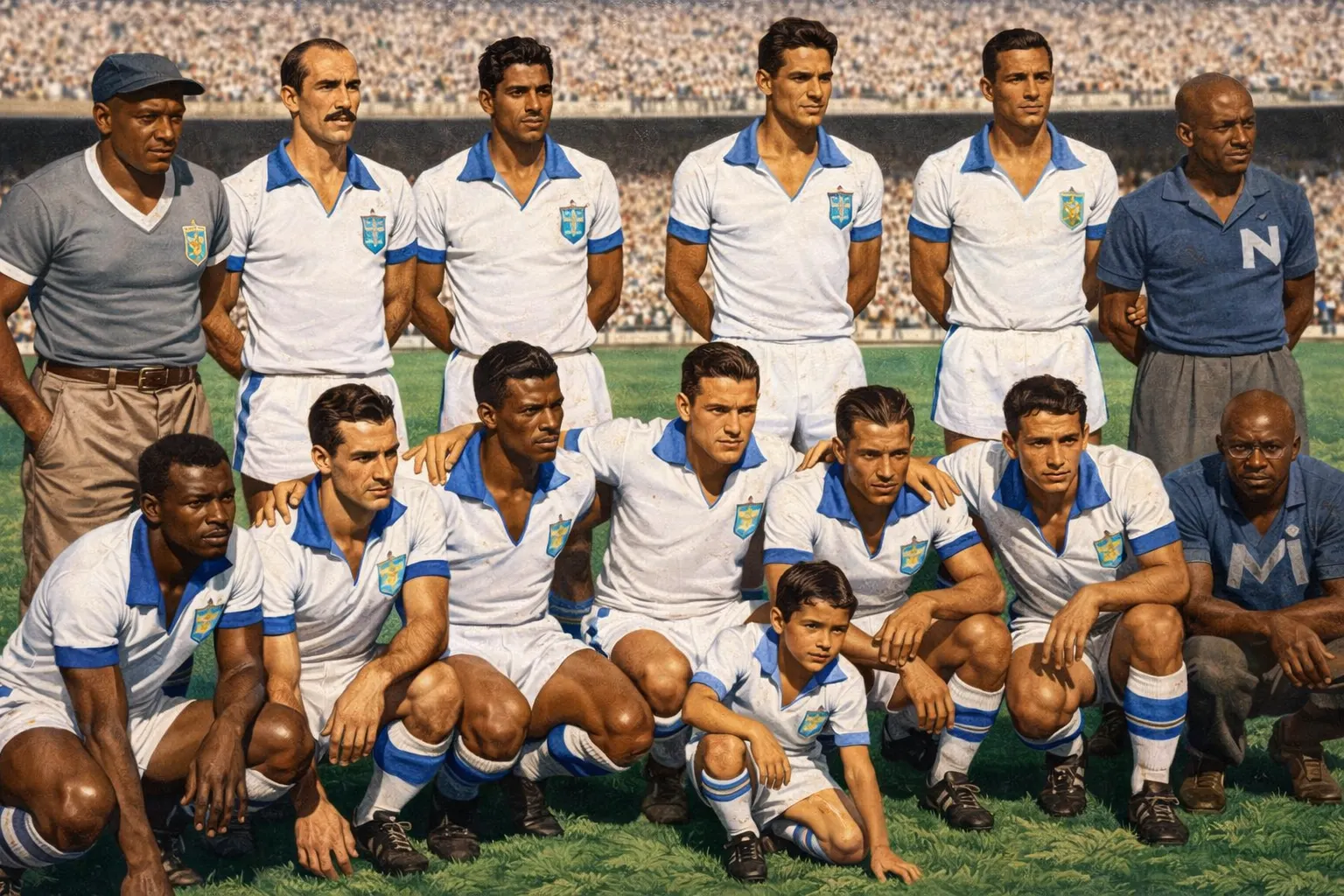 Brazil's 1950 squad – the most feared attacking unit in world football
Brazil's forward line — Ademir, Chico, Friaca, Zizinho, Jair — was the most feared attacking unit in world football. Uruguay, by contrast, had scraped through their pool. They'd drawn with Spain and barely beaten Sweden. Nobody in Rio was losing sleep over them.
They needed to win. To most of the 200,000 inside, that made the result a formality.
The Last Morning
The players arrived to find the Maracanã already shaking. The noise had been building since dawn. Mayor Ângelo Mendes de Morais addressed the Brazil squad in the dressing room before they went out: "You Brazilians, whom I consider victors of the tournament… you who in less than a few hours will be acclaimed champions by millions of compatriots… you who are so superior to every other competitor… you whom I already salute as conquerors."
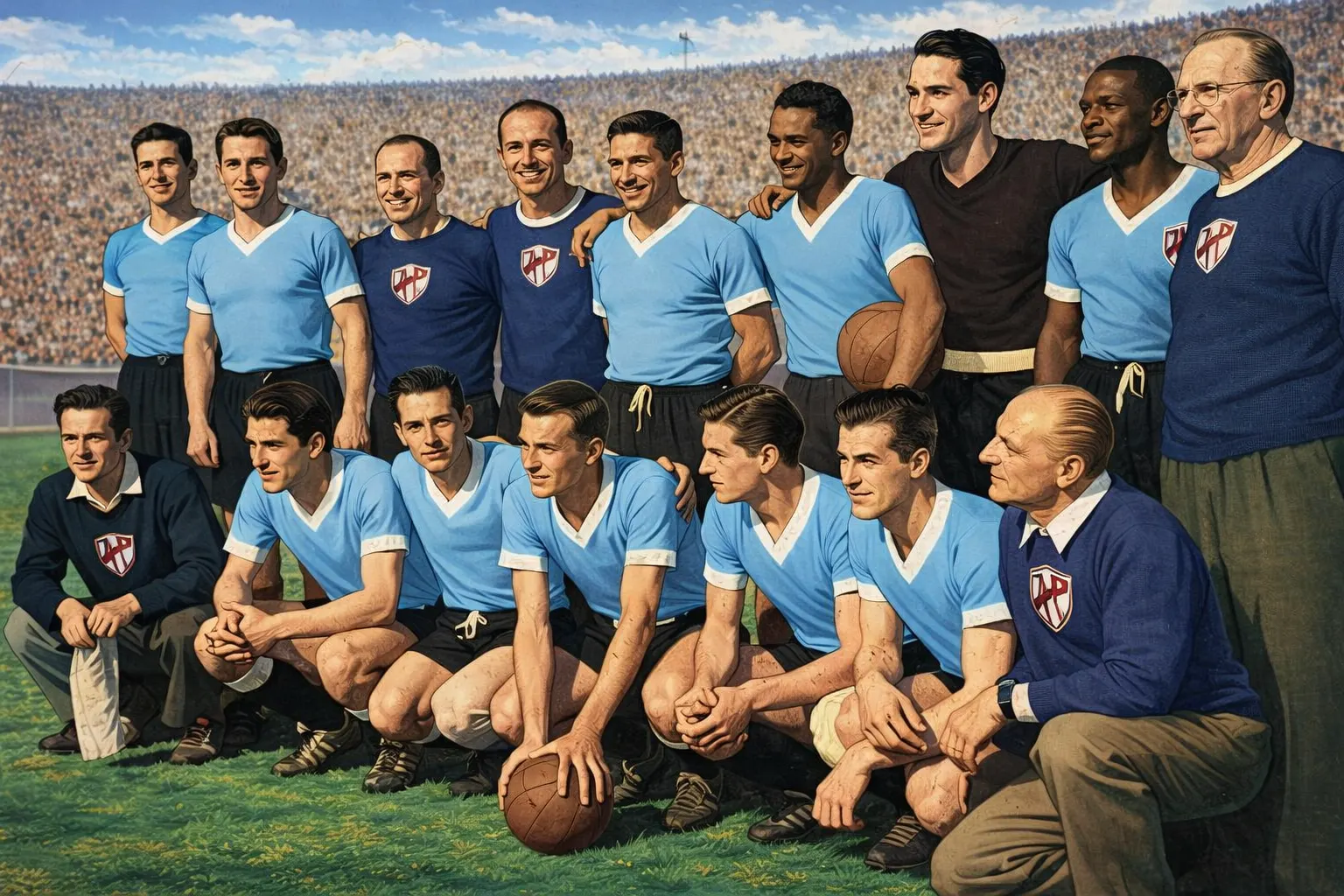 Obdúlio Varela and Uruguay's squad – dismissed as no real threat before kick-off
Down the corridor, Obdúlio Varela had gone out early that morning and bought up every Rio newspaper he could find. He spread them across the Uruguay dressing-room floor and told his teammates to walk over them. "Today, nobody remembers the past. Let them say what they want. We'll answer on the pitch."
The Match
Brazil scored after 47 minutes. Friaca cut inside and drove the ball past goalkeeper Roque Maspoli. The Maracanã erupted — a wall of sound so dense the players later said they couldn't hear teammates five yards away. Fireworks went off inside the ground. Brazilian staff were already working out the schedule for what came next.
Uruguay didn't fold. They kept coming. Not elegantly, not with any particular flair — they just refused to accept it. Schiaffino equalised in the 66th minute, converting a cross from Ghiggia on the right. A draw was still enough for Brazil. Twelve minutes left.
Then the 79th minute.
Ghiggia got the ball on the right again — same position he'd crossed from for the equaliser. Fullback Bigode moved to cut off the cross. Ghiggia saw the near post and kept running. He drove the ball hard and low, not a cross at all, threading it between Barbosa and the upright. The goalkeeper had shifted a yard toward the far post, reading a cross that never came. It was a fraction-of-a-second decision. A correct one.
The ball went in. 2-1 to Uruguay.
The Silence
Two hundred thousand people went quiet at the same time.
Not gradually. All at once. Journalists at the ground later struggled to describe it — several reached for the word "eerie" and then crossed it out, because that wasn't enough. Jules Rimet was holding his congratulations speech. He wrote afterwards: "The crowd became mute. Only then did I understand the meaning of that word. It was a silence so complete that you could hear individual sobs. I did not know what to do with the speech in my hands."
The presentation podium had been set up at pitchside for the trophy ceremony. Staff quietly began taking it apart before the final whistle. The gold medals were removed. The Rio parade was cancelled. No victory ode saw print.
When the whistle blew, Rimet handed the trophy to Varela with what witnesses called indecent haste — a brief handshake, no ceremony, no fanfare. He wanted to be done with it. The Uruguayans didn't celebrate on the pitch. They understood where they were.
Outside the stadium, Rio was silent. Police reported no disorder. People weren't composed. They were in shock.
Barbosa
Brazil needed someone to blame. The press nominated Moacir Barbosa, the goalkeeper beaten at the near post.
It was one of the most prolonged injustices in football history. Barbosa had been good throughout the tournament. The goal itself — low, fast, placed into a gap that existed for less than a second — was not a simple save. Ghiggia wasn't unlucky. He was precise. But grief doesn't accommodate precision, and in the weeks after the Maracanazo, Barbosa's name became shorthand for catastrophe.
He tried to move on. He never could. Fifty years of his life were defined by roughly 0.3 seconds he failed to get right.
In a supermarket in São Paulo sometime in the 1990s, a woman spotted him and turned to her young son. "Look at him," she said, loudly. "That's the man who made all of Brazil cry." Barbosa said later it was the worst thing that had ever happened to him. Worse than any headline. A stranger, a supermarket, a child, and a sentence that probably took five seconds to deliver.
When Brazil were preparing for the 1994 World Cup, coordinator Zagallo turned Barbosa away from the training camp. Not because of any recent failing. Because some in the setup believed he was bad luck. He was 64 years old. The goal had been conceded 44 years earlier.
In 2000, Barbosa somehow still had the goalposts from the Maracanã. He burned them in a barbecue. "Under Brazilian law," he said, "a man is innocent until proven guilty. But I have been convicted for fifty years." He died four months later, aged 79.
Ghiggia
Alcides Ghiggia outlived Barbosa by fifteen years. He died in 2015, aged 88, on July 16 — the 65th anniversary of the match to the day.
His most famous line: "Only three people have ever silenced the Maracanã: Frank Sinatra, Pope John Paul II, and me."
He said it with a straight face, and he wasn't wrong. But in later years, Ghiggia also talked about Barbosa — with something that sounded like genuine unease. He knew the goal was his, not a goalkeeper's error. That distinction mattered to him. He'd say it clearly, unprompted. It didn't change anything in Brazil, but he kept saying it anyway.
Yellow
The Maracanazo left one scar on Brazilian football that is still visible every time the national team plays: the colour of the shirt.
Brazil wore white at the 1950 World Cup. After the defeat, white became associated with the loss — with failure, with mourning. In 1953, a competition was held to redesign the national kit. A nineteen-year-old called Aldyr Garcia Schlee won with a yellow-and-green design using the colours of the Brazilian flag. The new kit debuted in 1954 and hasn't changed significantly since.
Decades later, someone asked Garcia Schlee if he was proud of it. He answered carefully. He was Uruguayan by heritage. He had, quietly, always supported Uruguay. "The worst of it," he said, "is that I created something that ended up being used all over the world, and I never wanted Brazil to win anything."
The man who gave Brazil their most iconic symbol. A Uruguayan.
Sources: João Máximo's reporting on the 1950 World Cup; David Goldblatt's "The Ball is Round"; Willy Meisl's contemporary match reports; interviews with Alcides Ghiggia published in El País and ESPN.