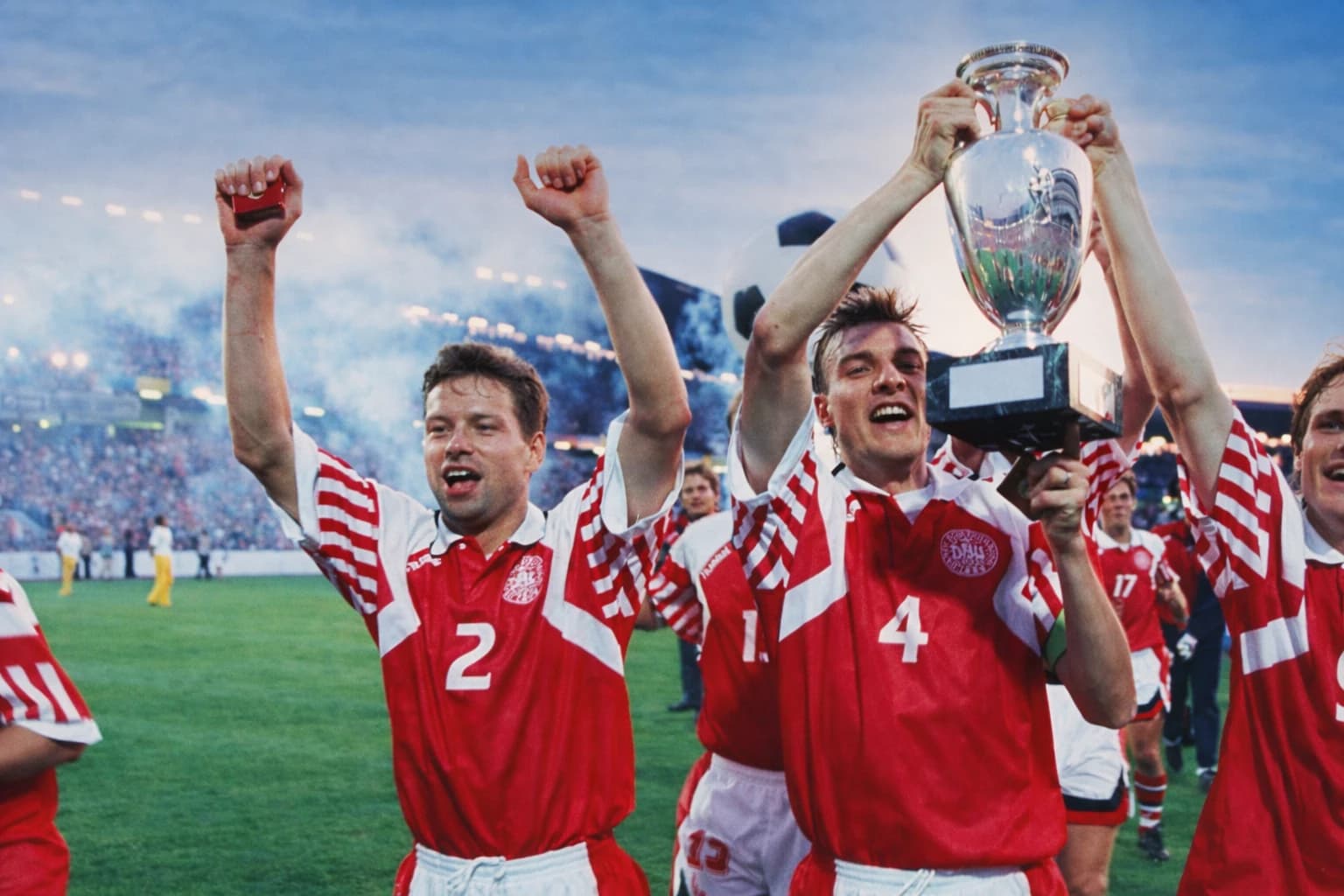
Denmark didn't qualify for Euro 1992. They got the call ten days before kick-off, reassembled a squad from summer holidays and club commitments, arrived in Sweden with no preparation — and won the whole thing. This is the most improbable title in football history, and the story of the man who scored the decisive goal while his daughter was dying.
Denmark Euro 92: The Team That Had No Right to Be There
Richard Møller Nielsen was working on his kitchen when the phone rang.
It was late May 1992, and the Denmark manager had settled into the quiet routine of a man with nothing on his calendar. His team had finished second in their qualifying group for the European Championship, behind Yugoslavia, and in 1992 second place didn't get you anywhere. The tournament was in Sweden, right across the water from Copenhagen, and Denmark would be watching it on television like everyone else. Møller Nielsen had accepted this. He was doing renovations around the house. He had plans that didn't involve football.
The phone call changed those plans. Yugoslavia, tearing itself apart in a civil war that would come to define the decade, had been expelled from the tournament by UEFA following United Nations sanctions. Resolution 757 came down on May 30. UEFA confirmed Yugoslavia's exclusion on May 31. Denmark, as runners-up in the qualifying group, were next in line. The European Championship started on June 10.
Ten days. To assemble a squad that had mentally checked out of international football for the summer. To prepare for a tournament they hadn't qualified for. To compete against the best national teams in Europe with what amounted to a skeleton plan and whatever fitness the players happened to be in.
What happened next is the most improbable championship run in the history of European football. Denmark didn't just show up. They won the whole thing. And the way they won it — who scored, who saved, and what one man in particular was carrying while he did it — makes this something more than just a great underdog story.
The Call
The details of the recall vary depending on which player is telling it, but the broad picture is consistent: nobody was ready.
Some players were on holiday. Others were wrapping up their domestic seasons and had no plans to play international football until the autumn. Brian Laudrup, one of Denmark's most gifted attackers, was finishing his time at Bayern Munich. John Jensen was at Brøndby. Kim Vilfort was at the same club, but his mind was somewhere else entirely — somewhere we'll come back to.
Peter Schmeichel, Denmark's goalkeeper and already one of the best in the world after his first season at Manchester United, recalled the chaos years later: "We were on holiday. Some of the boys had to be dragged off beaches. We hadn't trained together in months. There was no plan for this tournament because we weren't supposed to be at this tournament."
The Danish Football Association moved quickly. Calls went out. Players were told to report. There was no time for a proper training camp — no time to work on shape or set pieces or any of the things that normally fill the weeks before a major tournament. Denmark would arrive in Sweden with a squad, a system that Møller Nielsen had drilled into them during qualifying, and not much else.
What they didn't have was Michael Laudrup.
The Brother Who Wasn't There
Michael Laudrup was, in 1992, one of the best footballers on the planet. He was at Barcelona, playing under Johan Cruyff in the Dream Team that was rewriting how club football could look. He was creative, technically immaculate, and devastatingly intelligent with the ball at his feet. He was also not speaking to his national team manager.
The falling-out had happened during qualifying. The precise details depend on who you ask, but the core of it was a disagreement over tactics and role. Michael felt the manager's system was too rigid, too cautious, too unlike the football he was playing at Camp Nou. Møller Nielsen felt that Michael needed to serve the team rather than the other way around. Neither man moved an inch. Michael withdrew from the squad before the qualifiers were even finished.
When the call came for Euro 92, Michael didn't pick up. He stayed in Barcelona. Denmark would go to the European Championship without their most talented player.
This is worth sitting with for a moment, because it's the kind of absence that would normally gut a campaign before it started. Take any country's best creative player out of their squad — remove the one man capable of unlocking a game from nothing — and the tournament is usually already lost. Denmark lost their Michael Laudrup and decided to get on with it.
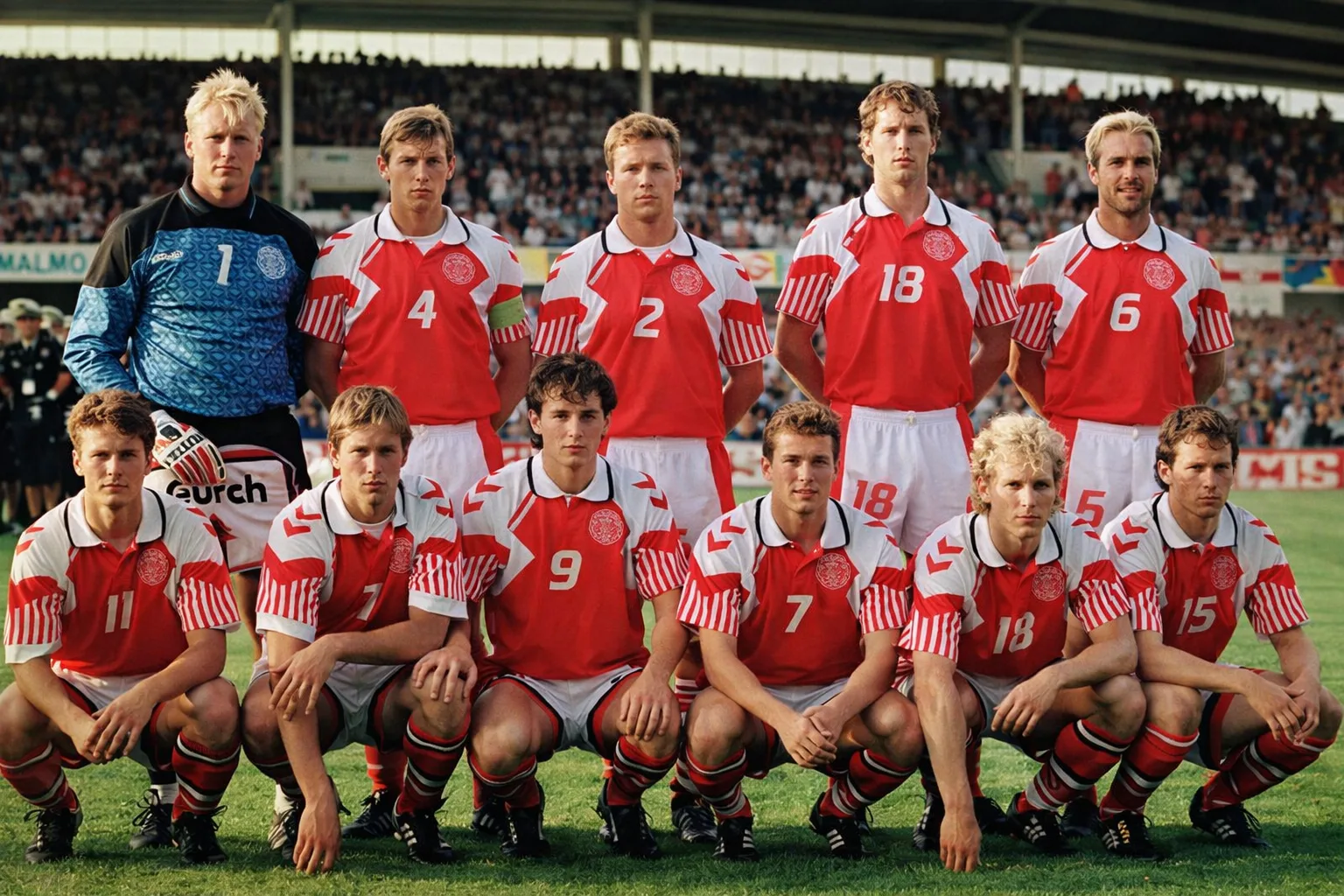 Denmark's Euro 92 squad — a group of players nobody expected to see at the tournament, let alone win it
The Group
Denmark were drawn into Group 1 alongside hosts Sweden, England, and France. On paper, it was a group designed to send them home inside a week.
The opening match, against England in Malmö on June 11, finished 0-0. It was cautious, physical, scrappy — exactly the kind of game you'd expect from a team that had been reassembled ten days earlier and flown across the Øresund with no clear idea of how far they could go. Nobody watching it thought Denmark were a threat. They looked like what they were: a side playing on borrowed time. But they didn't lose, and against England, not losing is always worth something.
Then Sweden beat them 1-0 in Stockholm three days later. The hosts were organized and aggressive and Denmark couldn't get anything going. Two games played, one point earned. They needed to beat France in their final group match to have any chance of advancing, and France had Jean-Pierre Papin, who'd just won the Ballon d'Or, Eric Cantona in his pomp, and Didier Deschamps holding things together in midfield. It was supposed to be the end of the road.
It wasn't. Henrik Larsen scored twice. Denmark won 2-1. France — who had beaten nobody and drawn with Sweden — went home. Denmark, with one win, one draw, and one defeat from their three matches, scraped through in second place behind the hosts.
Nobody outside Denmark was treating this as anything more than a delay. England had gone home. France had gone home. The Netherlands and Germany were the favourites. Denmark had squeezed through on the bare minimum and everybody expected the semi-final to put things in their proper order.
Møller Nielsen, asked after the France match whether his side could go any further, gave an answer that perfectly captured their position: "We have nothing to lose. We weren't even supposed to be here. Nobody expects a thing from us — and that is the most dangerous thing you can be in a tournament."
Gothenburg, June 22: The Dutch
The semi-final against the Netherlands should have been where the fairy tale ended.
The Dutch had a squad loaded with genuine world-class talent. Marco van Basten, who four years earlier had scored one of the greatest goals in European Championship history — that volley against the Soviet Union in the Euro 88 final. Ruud Gullit. Frank Rijkaard. Dennis Bergkamp, still in his early twenties and already brilliant. Ronald Koeman, sweeping up from the back. A team with winners' medals and the individual quality to beat anyone on their day.
Denmark had Peter Schmeichel, a well-organized defence, and the increasingly stubborn conviction that nobody had told them they were supposed to lose.
The match was pandemonium. Larsen — the same Henrik Larsen who had kept them alive against France — scored twice again. The Dutch equalized twice. Normal time ended 2-2. Extra time produced nothing decisive. Penalties.
This is where Peter Schmeichel earned something beyond his already considerable reputation. He was already one of the best goalkeepers in world football at Manchester United, but what he did in that shootout elevated him into tournament mythology. His presence on the line — physically enormous, arms spread wide, making the goal look half its actual size — visibly unsettled the Dutch penalty takers.
Marco van Basten stepped up. Four years earlier he'd been the best player in Europe. In Gothenburg, Schmeichel saved his penalty. The stadium tilted on its axis.
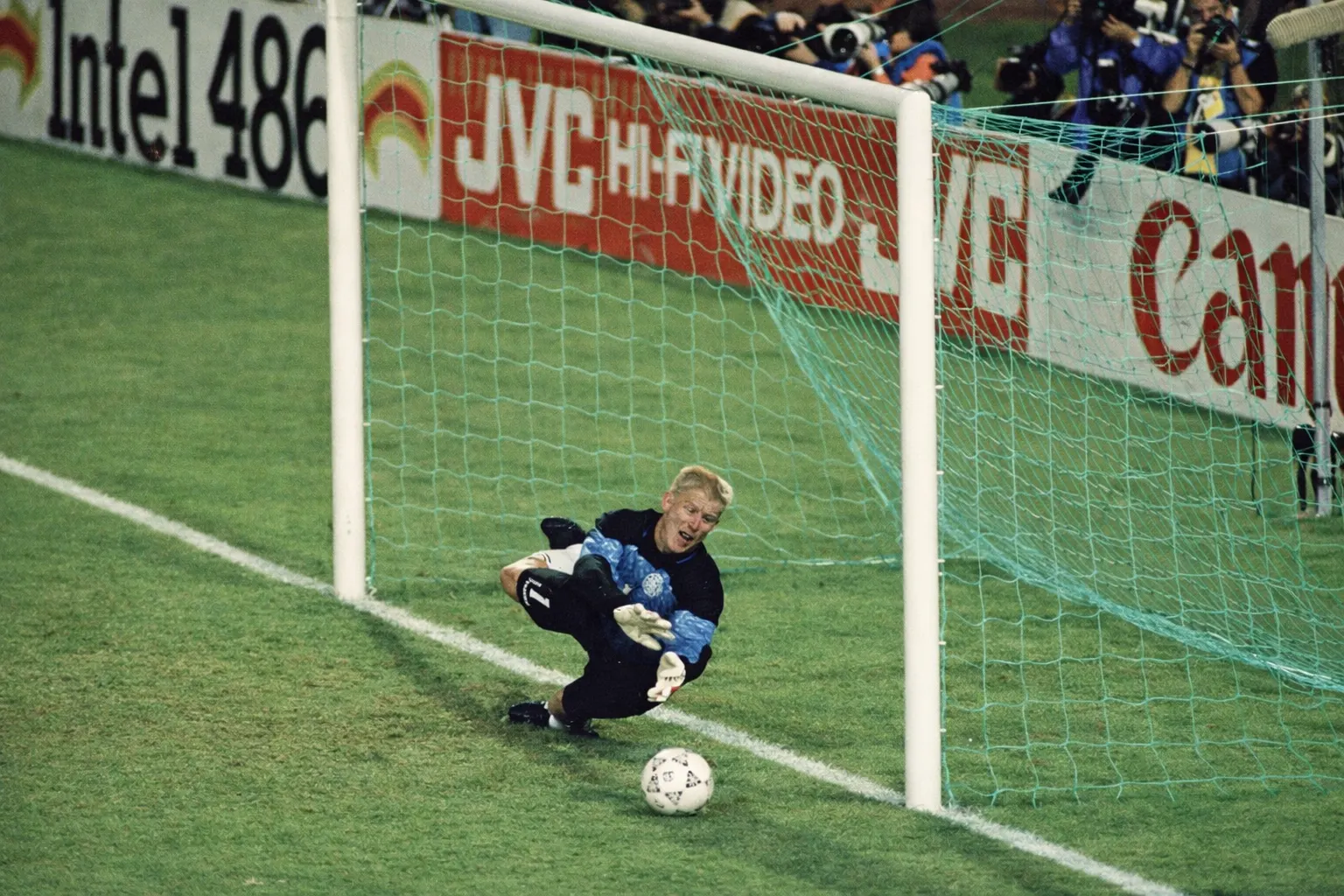 Peter Schmeichel denies Marco van Basten from the spot — the save that broke the Netherlands and sent Denmark to the final
Schmeichel, reflecting on penalty shootouts in his autobiography, described a philosophy that went beyond reflexes: "You have to make yourself as big as possible — not just physically, but in their heads. I wanted them to look at the goal and see no space. By the time van Basten stepped up, he was thinking about me. That's already half a save."
Denmark won the shootout 5-4. They were in the European Championship final. A team that hadn't qualified. A team that had been on holiday three weeks ago. A team without their best player. In the final.
Nobody could quite process it, including — by several accounts — the Danish players themselves.
Line
This is where the football story folds into something bigger, because underneath the results and the celebrations, something else was happening that makes all of it look different.
Kim Vilfort's daughter Line was seven years old, and she was dying.
She had been diagnosed with leukemia before the tournament. Vilfort, a midfielder at Brøndby and a regular in the national team, had every reason in the world not to go to Sweden. His daughter was in a hospital in Copenhagen. She was undergoing treatment. The prognosis was not good. Football, measured against any rational scale of what matters, did not matter at all.
He went anyway — because Line asked him to. That detail has been reported consistently over the years, and it's the kind of thing that resists embellishment because the bare truth of it is already more than enough. His daughter told him to play. So he played.
Vilfort, in a rare interview with Danish broadcaster DR years later, described the decision without any of the romanticism that others have attached to it: "Line said, 'Go play, Dad.' She wanted to watch the games on television. What do you say to that? So I went. And every time I came back to the hospital, she asked about the matches before I could ask about her treatment."
During the group stage, Vilfort flew back and forth between Sweden and Copenhagen to be at her bedside. The geography made it just about possible — a short flight, or a ferry and a drive across the Øresund. The emotional weight of the commute is harder to calculate. One day sitting with a seven-year-old in a hospital ward, the next day playing a European Championship match, then flying home again.
His teammates knew what he was going through. The coaching staff knew. Nobody discussed it publicly during the tournament. In 1992, some things were still allowed to stay private.
Vilfort played in every match. He didn't talk about it. He just kept showing up.
The Final: Gothenburg, June 26
Germany were expected to handle this without serious difficulty. They were the reigning World Cup champions — admittedly that title belonged to West Germany at Italia 90, but reunification had only deepened the squad's talent pool. Jürgen Klinsmann, Rudi Völler, Thomas Häßler, Karl-Heinz Riedle, Andreas Möller, Matthias Sammer — names that belonged in finals. Their coach, Berti Vogts, had built a side designed to win tournaments. Denmark were the opponents nobody had planned for, the punchline to a story that was supposed to have ended two rounds ago.
The Nya Ullevi stadium in Gothenburg was packed. Danish fans had poured across from Denmark by ferry, by car, by any means available. The Øresund Bridge wouldn't exist for another eight years, but that didn't slow anyone down. The atmosphere inside the ground was overwhelmingly red and white. A celebration that hadn't waited for permission.
Eighteen minutes in, John Jensen received the ball roughly twenty-five yards from goal. Jensen was a defensive midfielder at Brøndby. He was not, by any generous definition, a goalscorer. What happened after Euro 92 would prove the point definitively — he moved to Arsenal that summer and then went years without scoring a single league goal, a drought so extended it became a running joke on the North Bank at Highbury. But on June 26, 1992, in a European Championship final against Germany, he struck a shot from distance that flew past Bodo Illgner with the kind of ferocity that defensive midfielders are not supposed to have in them.
1-0 Denmark.
Germany pushed forward.They had over seventy minutes to find an equaliser, and they had the personnel to do it. Klinsmann was a constant threat. Möller probed and prodded. Schmeichel made saves — good ones, necessary ones, the kind that look comfortable on television replays but aren't when a World Cup winner is bearing down on you at full speed. Denmark defended with discipline and something that looked a lot like belief. The minutes crawled by. The pressure mounted. Everyone in the stadium was waiting for something to break.
In the 78th minute, Kim Vilfort got the ball on the edge of the German penalty area. He drove forward, shifted onto his right foot, and hit a low shot past Illgner. The goalkeeper got a hand to it. The ball went in anyway.
2-0.
Vilfort ran. His teammates engulfed him. In the stands, Danish fans who had arrived in Sweden as curious day-trippers with no expectations were screaming themselves hoarse. On the pitch, Vilfort had just scored the goal that would seal the most improbable European Championship in history.
His daughter was in a hospital bed four hundred kilometres away in Copenhagen.
The final twelve minutes were a formality. Germany had nothing left. The whistle blew. Denmark — unqualified, uninvited, unfathomable — were champions of Europe.
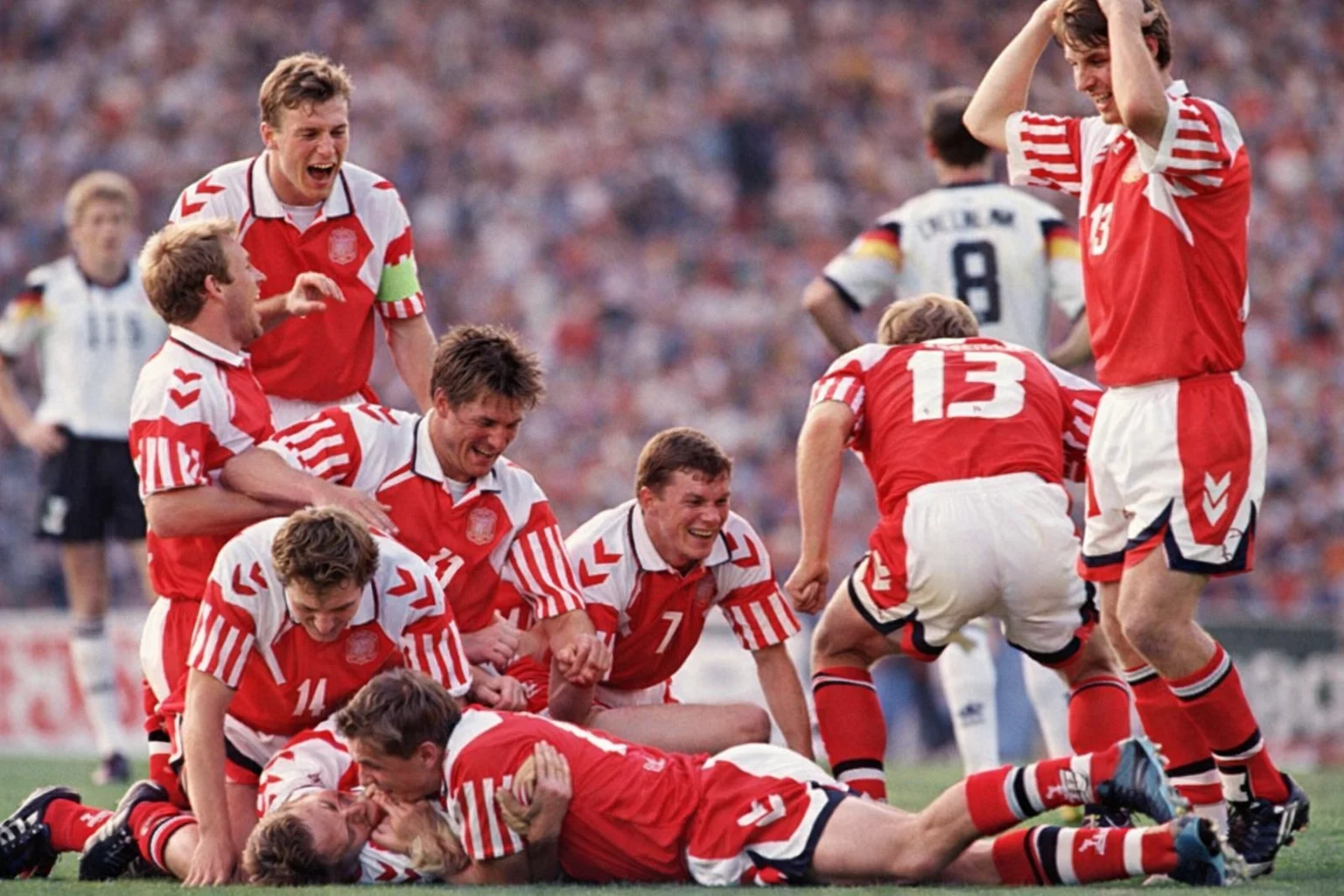 Danish players celebrate on the pitch after beating Germany 2-0 in the Euro 92 final — the most improbable championship in football history
Berti Vogts, the German coach, was measured in defeat: "You cannot take anything away from Denmark. They played with a freedom we could not match. When a team has nothing to lose and believes it completely, they become very hard to stop. Tonight they were impossible to stop."
After
The celebrations lasted for days. The squad flew home to Copenhagen and were greeted by crowds that filled the streets from the airport into the city. For a country of five million people, this was — and remains — the greatest sporting achievement in living memory. Nothing Denmark has done since has come close.
Møller Nielsen, the man working on his kitchen four weeks earlier, became a national hero overnight. He managed Denmark for another four years without ever recapturing what happened in Sweden. How could he? You don't replicate something that was never supposed to happen.
Michael Laudrup returned to the national team after the tournament. He played in the 1998 World Cup. He never won a European Championship. The irony of it isn't lost on anyone, and to his credit Michael has addressed the question over the years with more composure than most people would manage. He made a decision. It turned out to be the wrong one. He knows it.
Line Vilfort died on November 29, 1992. Five months after her father scored in the final. She was seven years old. Kim Vilfort has spoken about her occasionally in the decades since — carefully, without sentimentality, in the manner of someone who understands that certain things exist beyond football and that football, during one particular June, was the only thing keeping him upright.
I've watched the highlights of that final more times than I can count. Jensen's goal is spectacular in its sheer unexpectedness. Schmeichel's performance across the tournament — especially the Netherlands shootout — is remarkable. The collective discipline of a squad that had no business being competitive at this level is genuinely impressive. But the thing that elevates Denmark 92 beyond just another great underdog story — beyond Kaiserslautern's Bundesliga miracle or Wimbledon's FA Cup shock or any other against-the-odds tale — is Vilfort. A man playing football in Sweden while his daughter was dying in Denmark, who scored in a European Championship final and then went home to a hospital room. The joy and the grief existing in the same person at the same time, and neither one cancelling the other out.
That's not something you can plan for. It's not tactics. It's not even luck. It's something football occasionally produces that sits outside any analysis or explanation — a human story wearing a football shirt. Thirty-four years later, I still don't have a proper word for it.
Sources: Lars Eriksen and Mike Gibbons' "Danish Dynamite: The Story of Football's Greatest Cult Team"; contemporary match reports from The Guardian, The Independent, and the Danish broadsheet Berlingske Tidende; Peter Schmeichel's autobiography "One"; UEFA Euro 1992 official tournament records and match statistics; Kim Vilfort interviews published in Politiken and broadcast on DR Sport; Berti Vogts' post-final press conference via DPA.
All images in this article were generated using AI and do not depict real photographs.