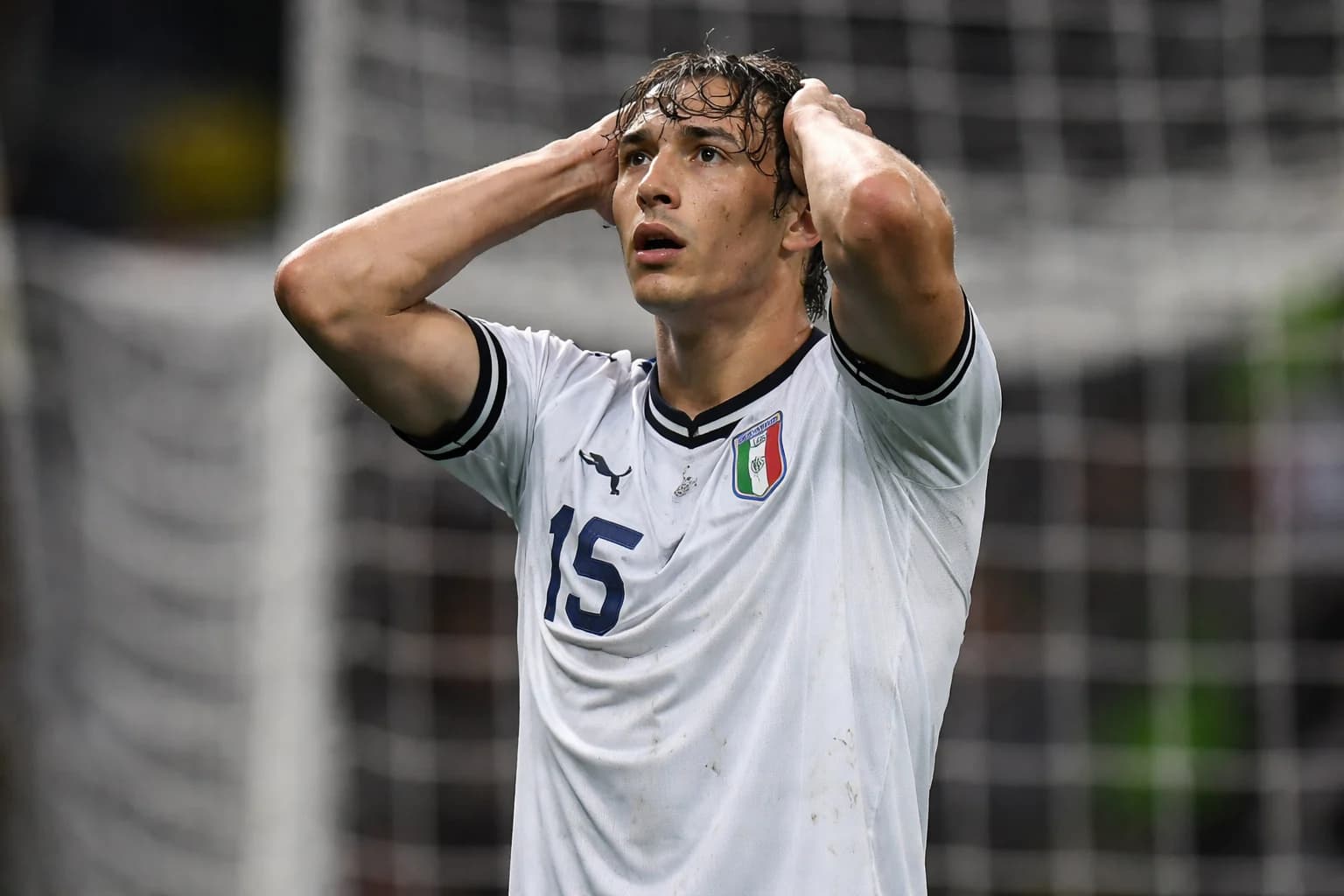
Three World Cups. Three failures to qualify. Italy — four-time world champions — have now missed the 2018, 2022, and 2026 tournaments. From Buffon's tears in Milan to Jorginho's missed penalties to the silence in Sarajevo, this is the story of a football superpower in freefall.
Italy's World Cup Exile: How Four-Time Champions Became Qualification Failures
The final whistle blew in Sarajevo and the Italian players stood exactly where they were. Some put their hands on their hips. Some dropped to the grass. A few walked in small, directionless circles — the posture of men who already knew this would happen but had spent ninety minutes convincing themselves it wouldn't.
Bosnia had done it. And Italy, for the third consecutive time, would not be going to the World Cup.
Not in 2018. Not in 2022. Not in 2026. A nation that has won this tournament four times — that gave the world Catenaccio and Paolo Rossi and the 2006 Berlin final — now hasn't played at a World Cup in twelve years. An entire generation of Italian fans has grown up without seeing their country at football's biggest stage. Some of them are old enough to drive.
This isn't a blip anymore. It isn't bad luck or tough draws or moments going the wrong way. This is something structural. Something broken at the foundation. And the most troubling part isn't that Italy keep failing to qualify. It's that each failure looks almost exactly like the last one.
Sarajevo, 2026: The Third Fall
The signs were there for anyone willing to read them. Italy's qualifying campaign had been plagued by the same familiar problems — promising starts that evaporated under pressure, creative midfields that couldn't find a final ball, and a finishing drought that turned matches they should have controlled into coin flips they kept losing.
Bosnia didn't need to be brilliant. They needed to be organized, physical, and patient. They were all three.
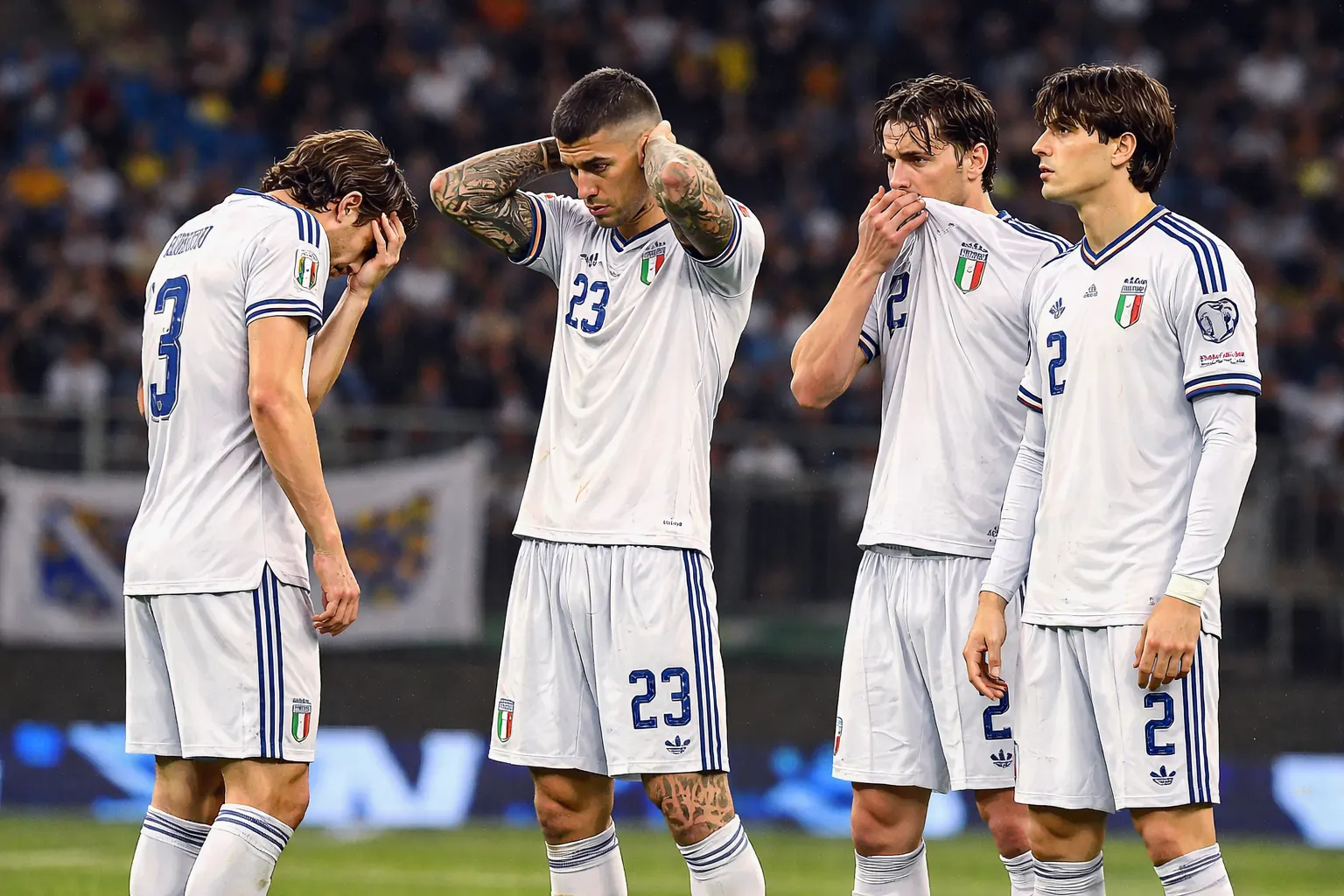 Italy players after the decisive World Cup 2026 qualification defeat in Sarajevo against Bosnia — a scene that has become painfully familiar
The Italians had more possession. They had more chances. They had more everything except the thing that actually matters, which is goals. The pattern was so recognizable by now that Italian journalists in the press box were writing their post-mortems before full time. They'd done it twice before. The paragraphs were already structured. Only the names and the city needed changing.
In the dressing room afterwards, the silence was total. No shouting. No recriminations. Just the hollow quiet of men who understood that the problem was bigger than any single result, any single campaign, any single manager. The problem was Italy.
Milan, 2017: Where It Started
On November 13, 2017, Italy played Sweden in the second leg of their World Cup playoff at the San Siro. They needed to overturn a 1-0 deficit from the first leg in Stockholm. Seventy-three thousand people packed the stadium. Most of them believed a comeback was inevitable. Italy had been to every World Cup since 1958. Missing one was something that happened to other countries.
Sweden defended. Not brilliantly, not with any particular ingenuity — they just defended. They put bodies behind the ball, they challenged every header, and they waited. Italy passed the ball sideways, tried to unlock something through the middle, failed, recycled possession, and tried again. For ninety minutes, the script repeated on a loop. Italy finished the match with plenty of possession and absolutely nothing to show for it.
The aggregate score stayed 1-0. Italy were out.
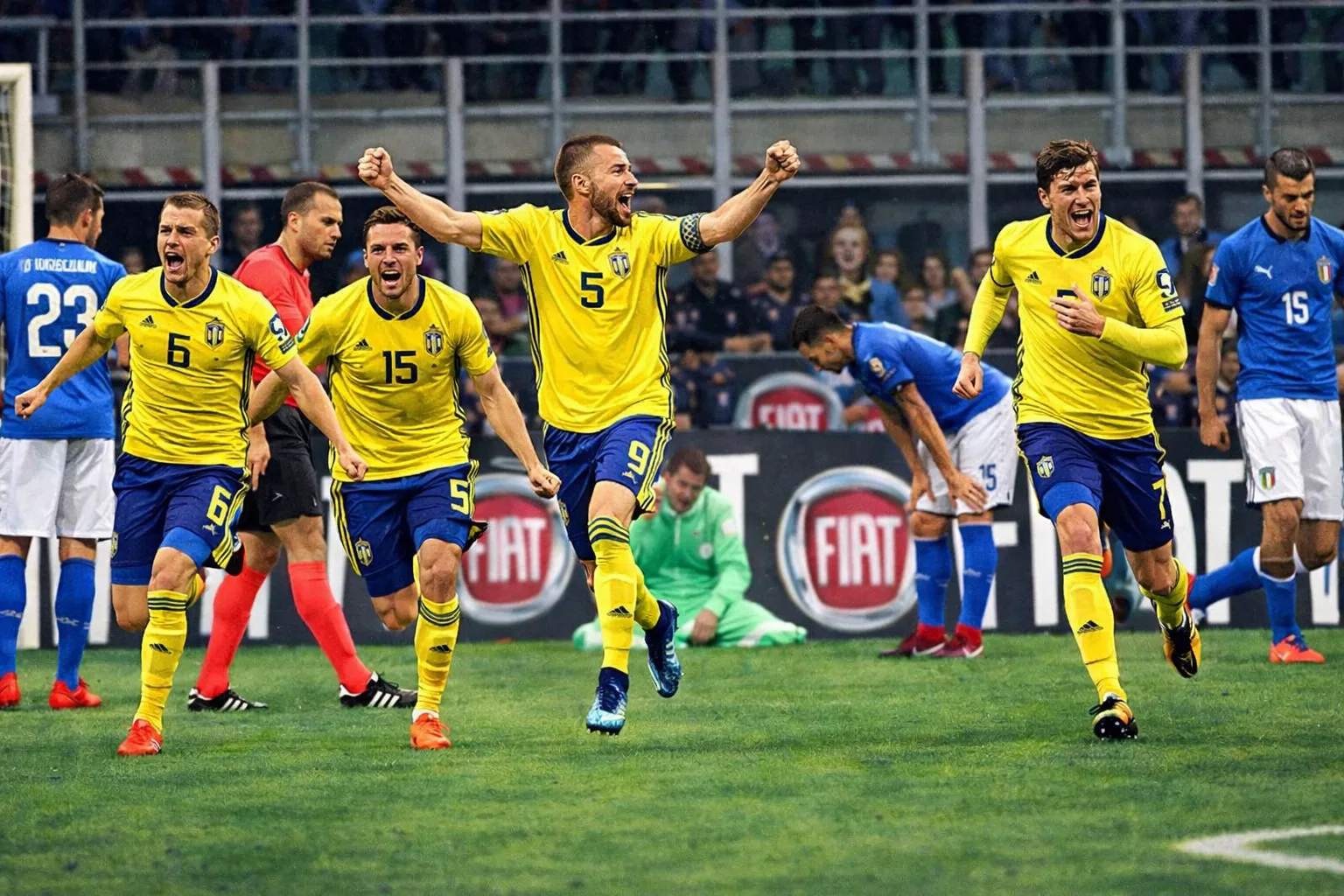 Italy vs Sweden, November 2017 — the night it all started, with Buffon's tears marking the end of an era
Gianluigi Buffon sat in the centre circle and sobbed. He was thirty-nine years old. He'd been Italy's goalkeeper for nearly two decades, through a World Cup win, through Calciopoli, through relegation with Juventus, through every high and low that Italian football had offered. This was his last game. He knew it in the moment and said so afterwards.
"I'm not sorry for myself but for Italian football," Buffon told reporters, his eyes red. "We failed at something which also means something on a social level. There is regret at not being able to take part in a World Cup. Blame is the wrong word. Responsibility is the right one."
The coach, Gian Piero Ventura, was sacked the next day. He became the easy answer. The press savaged him — his tactics were too conservative, he'd left the wrong players on the bench, he'd failed to adapt. All of it was true and none of it was the real problem.
Ventura was a symptom, not the disease. The disease was that Italy, once a production line of technically gifted, tactically intelligent footballers, had simply stopped producing them at the rate required.
Nobody said that out loud in November 2017. They blamed the coach, appointed a new one, and assumed the system would self-correct.
Palermo, 2022: The Cruelest Repeat
It did not self-correct. It got worse.
Between the Sweden disaster and the 2022 World Cup qualifying campaign, something remarkable happened. Roberto Mancini took charge, rebuilt the squad around young players, implemented an aggressive pressing style, and led Italy to the European Championship title in the summer of 2021. They beat England on penalties at Wembley. It was beautiful, fluid, modern football. It felt like redemption.
It wasn't. It was a mirage.
Within six months of lifting the Euro 2020 trophy, Italy's qualifying campaign began to disintegrate. They drew too many matches. They failed to beat Switzerland twice — both times because Jorginho, one of the best midfielders in the world, missed penalties. Not once. Twice. Two separate matches, two separate penalties, two separate chances to seal automatic qualification.
Both missed. The margins in qualifying are that thin, and Jorginho was on the wrong side of both.
Italy finished second in their group. Playoffs again.
On March 24, 2022, in Palermo, they faced North Macedonia in the playoff semifinal. Not Sweden. Not Portugal. Not anyone from the traditional European elite. North Macedonia — a country of two million people that had qualified for only one major tournament in its history. Italy were supposed to win this in their sleep.
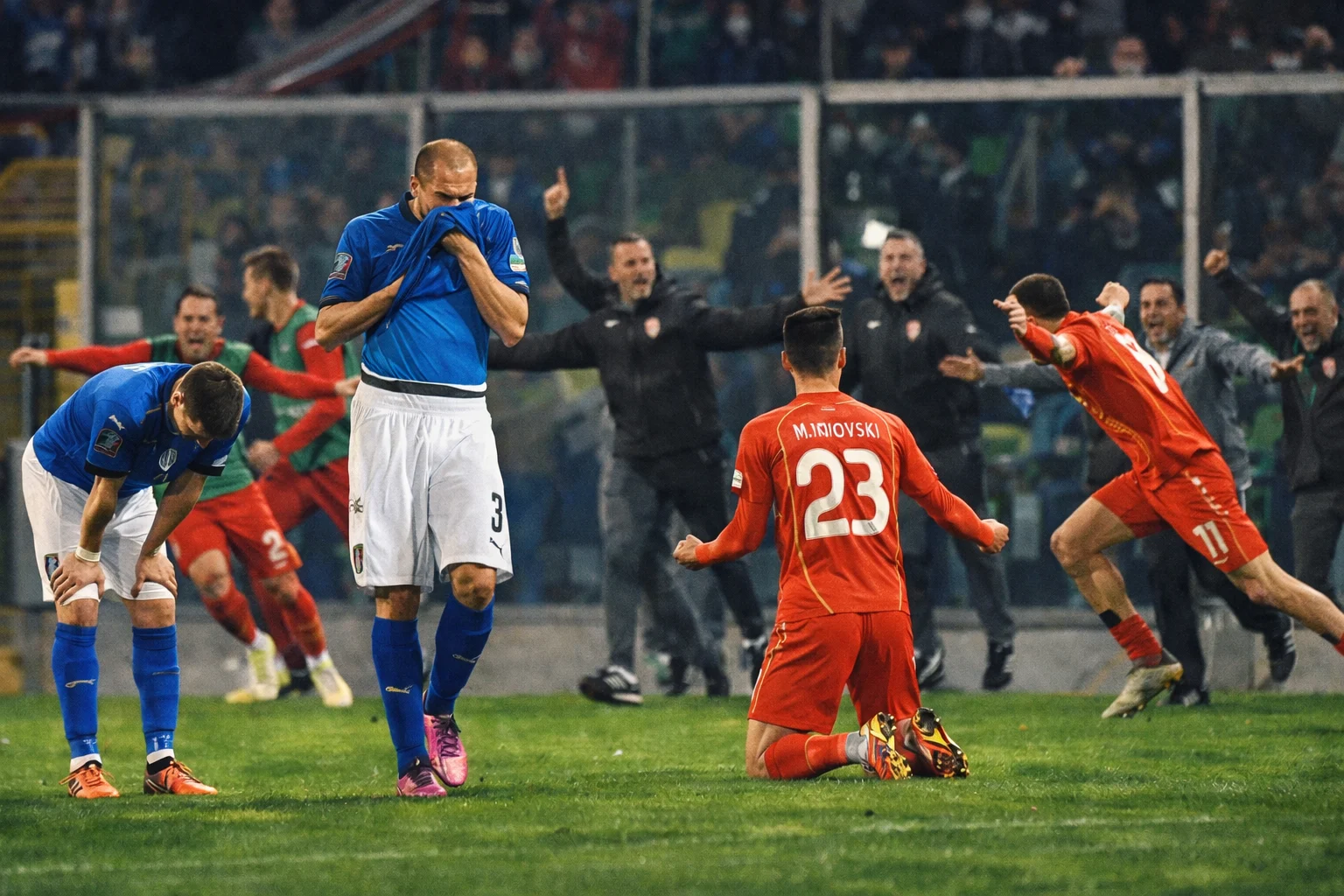 Italy's shock World Cup 2022 playoff elimination against North Macedonia — Trajkovski's last-minute winner that nobody saw coming
For eighty-nine minutes, Italy battered them. They had the ball constantly, created chances, forced saves. It felt like one of those nights where the goal would eventually come, because it always does. Except it didn't — not for Italy.
In the 92nd minute, North Macedonia broke forward. Aleksandar Trajkovski collected the ball thirty yards out, looked up, and hit a shot that dipped viciously past Gianluigi Donnarumma. The net rippled. The stadium went quiet. That specific silence — the one where tens of thousands of people exhale at the same time and produce nothing — Italy was hearing it for the second time in five years.
Final score: Italy 0, North Macedonia 1. The reigning European champions would not be going to Qatar.
Mancini stood on the touchline with his hands in his pockets. He'd done something genuinely impressive with this squad. He'd given them an identity, a system, a way of playing that had won them a continental championship. And none of it mattered because they couldn't qualify for the World Cup, which is the one thing Italian football cannot accept failing at.
He lasted another year before resigning. The cycle continued.
The Factory Broke
Strip away the individual matches and the story becomes clearer. Italy's World Cup exile isn't about Sweden's defence or Trajkovski's long-range shot or anything that happened in Sarajevo. It's about a football ecosystem that used to produce world-class talent at industrial scale and no longer does.
In the 1990s and early 2000s, Serie A was the best league in the world. The best players from every continent went to Italy. Italian clubs invested in youth development not because they were idealistic but because it was profitable — produce a Maldini, a Del Piero, a Totti, and you saved yourself a transfer fee while gaining a player who understood Italian football's tactical demands at a molecular level.
Then Calciopoli happened. Juventus were relegated. AC Milan were docked points. The reputational damage sent a signal to global talent: Serie A was broken, maybe corrupt, certainly no longer the destination. The Premier League, already growing faster commercially, accelerated past. La Liga had Messi and Ronaldo. The Bundesliga offered modern facilities and better atmospheres. Serie A offered crumbling stadiums, declining TV revenue, and a match-fixing shadow that took a decade to fully lift.
Italian clubs responded by cutting youth investment and buying cheaper foreign players. The pipeline that had once fed the national team with fifteen or twenty viable internationals per generation started producing five or six. And five or six world-class players is enough to win a European Championship on a good week, but it is not enough to sustain a two-year qualifying campaign where consistency matters more than peaks.
Look at the comparison. Spain restructured their entire youth system after Euro 2004 and built a dynasty. Germany did the same after their disastrous Euro 2000 and produced a generation that won the 2014 World Cup. France invested in their suburban academies and now have the deepest talent pool in world football. Italy looked at the same evidence and did almost nothing.
The FIGC — Italian football's governing body — cycled through coaches and strategies without ever addressing the structural problem. Every failure was treated as a tactical issue. Change the manager, change the formation, change the personnel. Never change the system. Never ask why a country of sixty million people, with football as its national obsession, cannot produce enough top-level players to comfortably qualify for a World Cup — even one expanded from thirty-two teams to forty-eight.
The Euro 2020 Lie
This is what makes the Mancini era so painful in hindsight. Euro 2020 wasn't evidence that Italy were fixed. It was evidence that a brilliant coach, given three years and a specific group of players who peaked simultaneously, could assemble a tournament squad good enough to win seven matches in a row.
The spine of that team — Donnarumma, Bonucci, Chiellini, Jorginho, Verratti, Insigne, Immobile — was outstanding for exactly one summer. Within a year, Chiellini retired. Insigne left for MLS. Immobile's international record remained bafflingly poor. Verratti was perpetually injured. The squad that had looked so deep and so balanced at Wembley suddenly looked thin and old, because it was both.
Mancini couldn't replace them. Not because he didn't try, but because the replacements didn't exist. The production line had been broken for too long. You don't rebuild a national team talent pipeline in three years. Spain needed eight. Germany needed ten. Italy hadn't started.
The European Championship win gave everyone permission to ignore the deeper crisis for another eighteen months. When the crisis reasserted itself in Palermo, it felt sudden. It wasn't sudden at all. It had been building for a decade.
The Weight of the Shirt
There is a human cost to this that doesn't show up in qualifying tables.
Buffon carried the 2017 failure as the final act of a legendary career. He deserved a better ending. He knew it. Everyone knew it. The image of him weeping at the San Siro became the defining photograph of Italian football's decline — more powerful than any statistic or tactical analysis because it showed what losing actually looks like up close.
Jorginho carried the 2022 failure differently. His two missed penalties against Switzerland weren't the only reason Italy finished second in their group, but they were the most visible reason, and in football, visibility is everything. He went from a Champions League and European Championship winner to the man who missed the penalties. The internet was cruel. The Italian press was crueler.
The players who lost in Sarajevo will carry this one too. Different names, same weight. The Azzurri shirt demands World Cup qualification as a minimum. It is not optional. It is not acceptable to miss. And when you miss three in a row, every player involved absorbs some fraction of a failure that is institutional, not individual, but feels completely personal in the moment.
What Now?
Italy will try again. They always try again. A new coach will be appointed if one hasn't been already. A new cycle will begin. Young players will be identified, blooded, integrated. The language will be about renewal, about building, about learning from mistakes. The same language was used after 2017. And after 2022. The words haven't changed because the underlying approach hasn't changed.
The forty-eight-team World Cup format that begins in 2026 was supposed to make qualification easier. More spots meant more margin for error. Italy are demonstrating that no format is generous enough if the talent base has eroded far enough. Expanding the tournament doesn't help if you cannot beat Bosnia in Sarajevo.
For the first time, there is a serious conversation happening in Italian football about whether the problem is existential rather than cyclical. Whether the golden age — the decades when Italian football was synonymous with tactical brilliance and defensive mastery — was the product of a specific set of economic and cultural conditions that no longer exist and may never return. Whether Italy are not underperforming their potential but performing exactly at it.
That is a terrifying thought for a country that defines part of its national identity through football. But three consecutive World Cup absences demand terrifying questions. The comfortable ones have already been asked. They didn't lead anywhere useful.
Somewhere, a twelve-year-old Italian kid is watching club football on television and has never seen their country play at a World Cup. They were born after Russia 2018. They were too young for Qatar 2022. They won't see the USA, Canada, and Mexico in 2026.
The next World Cup is in 2030. Italy will try to qualify. The question is no longer whether they deserve to be there. The question is whether the system that once made them permanent residents of football's top table can be rebuilt in time — or whether the exile is just how things are now.
Four stars sit above the crest on the Italian shirt. One for each World Cup won. They are starting to feel less like a record of achievement and more like a reminder of what used to be true.
Sources: Gianluigi Buffon's post-match interview with Rai Sport, November 2017; FIFA World Cup qualifying records and match reports; UEFA Euro 2020 tournament archives; Jonathan Wilson's coverage of Italian football's structural decline in The Guardian; Gabriele Marcotti's analysis of Serie A's talent pipeline in ESPN; FIGC annual reports on youth development investment; contemporary match reports from Reuters, BBC Sport, and La Gazzetta dello Sport.
All images in this article were generated using AI and do not depict real photographs.