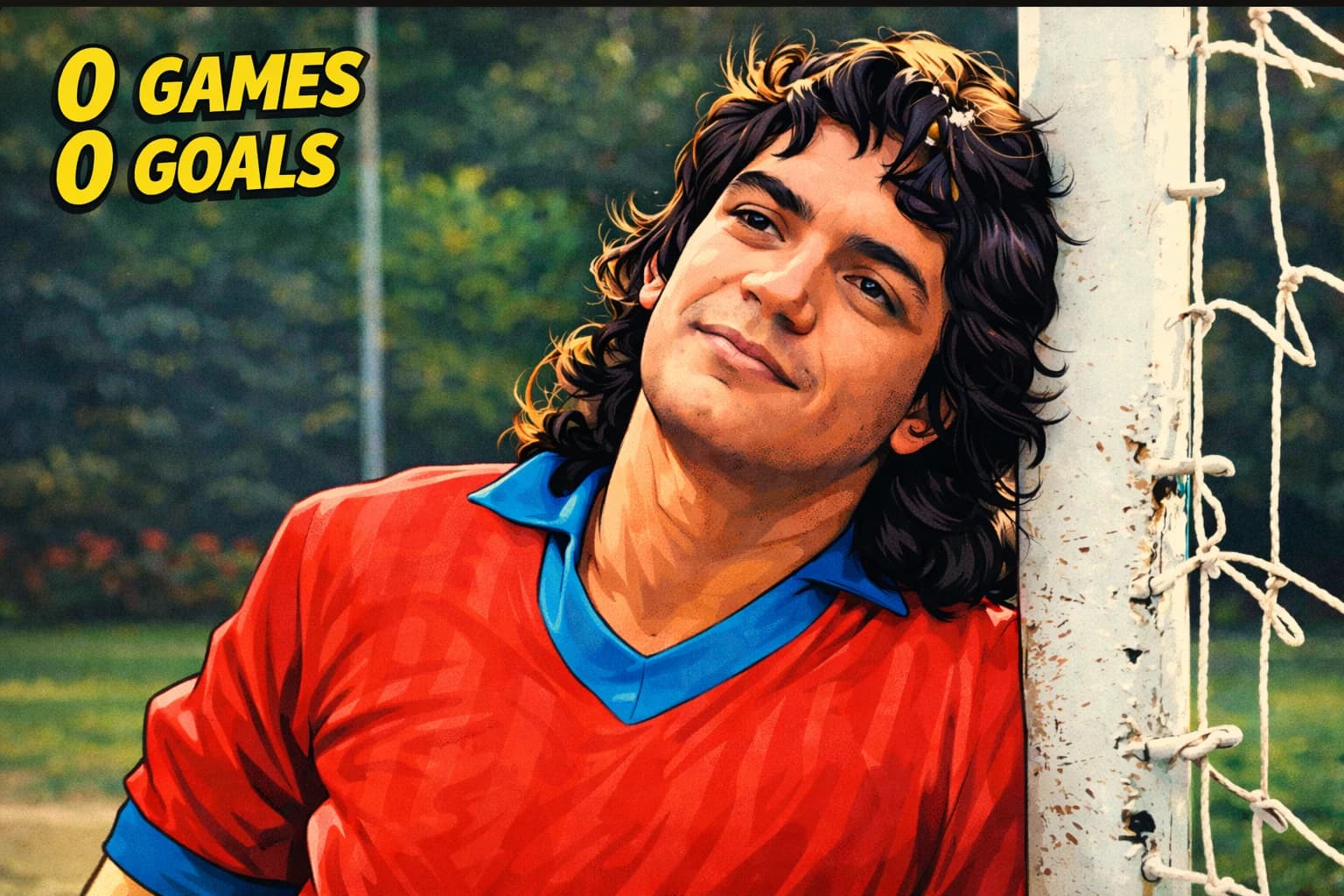
For over 20 years, Carlos Kaiser convinced clubs across Brazil and beyond to sign him as a professional footballer. The twist? He never actually played. Meet the greatest con artist in football history.
In the history of football, there have been many frauds, impostors, and chancers who tried to fake their way into the professional game. Most were caught within days or weeks. But Carlos Henrique Raposo, better known as Carlos Kaiser, operated at the highest level for over two decades, signing contracts with more than ten professional clubs, training alongside legends like Romario and Carlos Alberto, and earning a comfortable living – all without ever playing a single minute of competitive football. His story isn't just about deception; it's about charisma, creativity, and understanding that in football, perception can be more valuable than ability.
The Birth of a Con Artist
Carlos Henrique Raposo was born in 1963 in Rio de Janeiro, Brazil. As a teenager, he had genuine football talent and played in youth academies. But as he progressed through the ranks, a harsh reality became clear: he was good, but not good enough for professional football. He had decent technique and understanding of the game, but he lacked the physical attributes, pace, and mental strength to compete at the top level.
Most players in his position would have accepted reality and moved on – perhaps to lower divisions, perhaps to another career entirely. But Kaiser had something that most footballers don't: incredible social intelligence, supreme confidence, and an understanding that in Brazil's chaotic football scene of the 1980s, networking and image could matter more than actual ability.
His nickname came from his admiration for Franz Beckenbauer, the German legend known as "Der Kaiser." Carlos decided that if he styled himself as Brazil's Kaiser, people might actually believe he was a player of similar caliber. The con had begun.
The First Con: Botafogo
Kaiser's breakthrough came in 1979 when he convinced Botafogo, one of Rio's biggest clubs, to give him a trial. He had no real connections at the club, but he talked his way into a training session by claiming he had been recommended by a famous player. Once there, he impressed in the informal kickabouts before training – the relaxed games where he could show his technique without the pressure of competitive situations.
When formal training began, Kaiser complained of a minor injury. He would train lightly, jogging around the pitch and doing basic exercises while avoiding any actual football that might expose his limitations. After a week of this, he convinced the coaches to sign him to a short-term contract, promising he would be ready soon. Once signed, the injuries became more serious – always just serious enough to keep him out of matches but not so serious that the club would terminate his contract.
This pattern would define his entire career. Sign a short-term contract, claim injury, train lightly while socializing with players and staff, and then either get released when the contract expired or, ideally, convince another club to sign him based on his reputation and connections before the current club realized he was useless.
The Art of the Fake Injury
Kaiser's fake injuries were legendary. He studied real players' injury patterns and medical reports so he could describe symptoms convincingly. He would arrive at the training ground limping, wincing in pain, and immediately head to the medical staff. His go-to injuries were always soft tissue problems – hamstring strains, groin pulls, minor knee issues – that were difficult to disprove and required "rest and rehabilitation."
When pressed to do fitness tests, he had a arsenal of tricks. He would aggravate minor injuries during warm-ups, accidentally-on-purpose pulling up during sprints. He once reportedly paid a teammate to kick him hard during a training match, giving him a legitimate bruised thigh that kept him out for weeks. Another time, he faked a fever by drinking hot coffee before having his temperature taken by the team doctor.
The beauty of his system was timing. He would sign contracts during the off-season when there were no competitive matches. By the time the season started, he had already built enough relationships that people wanted to believe in him. When injuries kept him out of games, coaches and teammates would express sympathy rather than suspicion. After all, everyone knew Kaiser was talented – they'd seen him in training. Surely he'd be back soon.
The Celebrity Friends
 Carlos Kaiser with Renato Gaúcho – Networking was his real talent
Kaiser's greatest weapon wasn't his footballing ability – it was his social network. He befriended some of Brazil's biggest football stars, and these connections became his passport to new clubs. His best friend was Romario, the legendary striker who would go on to win the World Cup in 1994. Kaiser and Romario grew up in the same neighborhood, and their friendship was genuine. But Kaiser also understood that being Romario's friend opened doors.
When Romario joined PSV Eindhoven in the Netherlands, Kaiser would visit him, taking photos and posting them in Brazilian newspapers. When Romario returned to Brazil to play for clubs like Flamengo and Vasco da Gama, Kaiser would be there, training with him, socializing with the squad, and convincing coaches that if he was good enough to be Romario's friend, he must be a decent player.
He also befriended Carlos Alberto, the captain of Brazil's 1970 World Cup-winning team. Carlos Alberto had become a coach and agent, and Kaiser leveraged this connection ruthlessly, using Carlos Alberto's name to get trials and contracts at various clubs. He partied with famous players, dated models and actresses, and lived a lifestyle that suggested he was a successful footballer – which, in a way, he was, just not in the traditional sense.
The Greatest Performance: Ajaccio
Kaiser's masterpiece came in 1985 when he convinced Ajaccio, a French club, to sign him. How did a Brazilian footballer with no real professional experience get signed by a European club? Through sheer audacity and creative lying.
Kaiser had been hanging around Flamengo, one of Brazil's biggest clubs, befriending players and learning about potential transfers to Europe. When he heard that Ajaccio was interested in signing Brazilian players, he created fake recommendation letters, allegedly from Flamengo officials, praising his ability. He sent photos of himself in Flamengo training gear (he had never actually been signed by Flamengo) and highlighted his "experience" playing alongside Brazil's top stars.
Ajaccio, desperate for Brazilian flair and lacking the resources to thoroughly scout players, took the bait. They flew Kaiser to France and signed him to a contract. The problem, of course, was that he would now have to play actual matches.
 Kaiser's presentation at Gazélec Ajaccio (or was it?)
Kaiser's solution was brilliant. During his first training session, he started a fight with one of the team's star players, deliberately getting himself sent off and "injured" in the scuffle. He then claimed he couldn't train properly because of the injury and the hostile environment created by the fight. He complained to management about the team's treatment of Brazilian players and eventually negotiated a contract termination with a small payout. He had successfully conned his way into and out of a European club within weeks, earning money and adding "played in France" to his resume.
The Fake Comeback
Throughout the 1990s, Kaiser perfected his craft. He would disappear for months, letting people forget about him, then resurface at a new club with new stories about injury comebacks and untapped potential. His network of friends in Brazilian football meant there was always someone willing to give him a chance, either because they genuinely believed in him or because he convinced them it would be good publicity.
At Bangú, he lasted several months by constantly getting "injured" during training. At Vasco da Gama, he managed to train with the first team while on trial, taking photos with star players and using those photos to convince other clubs he was a Vasco player. At Puebla in Mexico, he lasted three weeks before getting "injured" and returning to Brazil.
His longest stint was at Gazélec Ajaccio (a different club from his earlier Ajaccio adventure) where he somehow convinced the coaching staff that his injuries were genuine and that once fit, he would be a valuable player. He spent over a year there, mostly "injured," before finally being released when the club's patience ran out.
The Few Times He Actually Played
The remarkable thing about Kaiser's career is that he occasionally did have to play, and when that happened, disaster followed. In one famous incident at Botafogo, he was forced to come on as a substitute because the team had no other options. Kaiser's solution was to immediately commit a professional foul, earning a red card and getting sent off within minutes. He later claimed he did it to "show his warrior spirit" and "protect the team."
Another time, at Fluminense, he was named in the squad for a match and knew he might have to play. Before the game, he organized a group of friends to invade the pitch during warm-ups, creating chaos. In the confusion, Kaiser picked a fight with one of the invaders (who was his friend) and got "injured," forcing him to miss the match. It was pure theater, and it worked.
These moments of quick thinking saved his career multiple times. Whenever he was cornered, whenever it looked like he would finally be exposed, he would create chaos, fake an injury, or manufacture a reason why he couldn't play. His creativity in avoiding matches was more impressive than most players' ability to perform in them.
The Social Media Era and Confession
Kaiser's career as a fake footballer essentially ended in the early 2000s as Brazilian football became more professional, with better scouting, medical checks, and record-keeping. It was harder to fake your way through multiple clubs when your entire history could be checked online. Kaiser's network of friends was also aging, and new generations of coaches and executives didn't have the same personal connections that had protected him for so long.
In 2013, Kaiser publicly admitted his deception in interviews with Brazilian media. Rather than facing condemnation, he became a cult hero. A documentary called "Kaiser! The Greatest Footballer Never to Play Football" was released in 2018, detailing his exploits. Far from being ashamed, Kaiser embraced his role as football's greatest con artist, giving interviews, appearing at events, and even writing an autobiography.
His confession revealed the full extent of his deception: over 20 years at more than ten professional clubs without playing a single competitive minute. He had earned money, lived well, partied with superstars, and fooled everyone. And rather than anger, many people responded with admiration for his audacity and social intelligence.
Why Did It Work?
Kaiser's success reveals something fascinating about football culture, particularly in Brazil during the 1980s and 1990s. The game was less professionalized, clubs were more chaotic, and personal relationships mattered more than data or statistics. A player's reputation and connections could get him signed regardless of actual ability. Medical checks were less rigorous, and coaches often relied on gut feeling rather than comprehensive analysis.
Kaiser also understood human psychology. He knew that people want to believe in potential, in the talented player who is just one recovery away from brilliance. He exploited this optimism ruthlessly. He also knew that once someone had invested in him – signed him, praised him publicly, recommended him to others – they would be reluctant to admit they'd been fooled. It's easier to believe the player is just unlucky with injuries than to accept you've been conned.
The Legacy of a Fraud
Carlos Kaiser never kicked a ball in a competitive professional match, yet his story is more famous than many actual footballers of his era. He's proof that in football, as in life, charisma and social intelligence can sometimes matter more than talent. He exposed the weaknesses in football's structures and showed how easy it was, in a certain time and place, to fake your way to the top.
Is he a villain or a folk hero? A con artist or a creative genius? The answer probably depends on your perspective. He didn't steal from fans, fix matches, or harm anyone directly. He simply convinced clubs to pay him for doing nothing, which, in a world where many footballers are grossly overpaid, doesn't seem like the worst crime.
Today, Kaiser lives comfortably in Rio de Janeiro, occasionally giving interviews and enjoying his status as football's most lovable fraud. He remains friends with many of the stars he befriended during his "career," including Romario, who still laughs about their adventures together. When asked if he has any regrets, Kaiser simply smiles and says he lived the dream – he got paid to be a footballer without having to endure the pressure of actually playing.
The Lessons of Kaiser
In an age of data analytics, sports science, and comprehensive background checks, a Carlos Kaiser couldn't exist today. Modern football's professionalization has closed the loopholes he exploited. But his story remains a reminder that football, for all its sophistication, is still a human game, vulnerable to human weaknesses like vanity, wishful thinking, and the desire to believe in a good story.
Carlos Kaiser didn't win trophies, break records, or score memorable goals. But he achieved something arguably more impressive: he convinced the football world that he was a player for over two decades without ever proving it on the pitch. In a sport obsessed with statistics and achievements, he is the ultimate outlier – the footballer who never played, yet whose story will be told for generations.
And perhaps that's the final con: even in retirement, even after confessing everything, Carlos Kaiser made people care about him. He turned his fraud into fame, his deception into a documentary, and his lies into a legacy. In a way, he achieved what every footballer dreams of – immortality. He just took a very different path to get there.