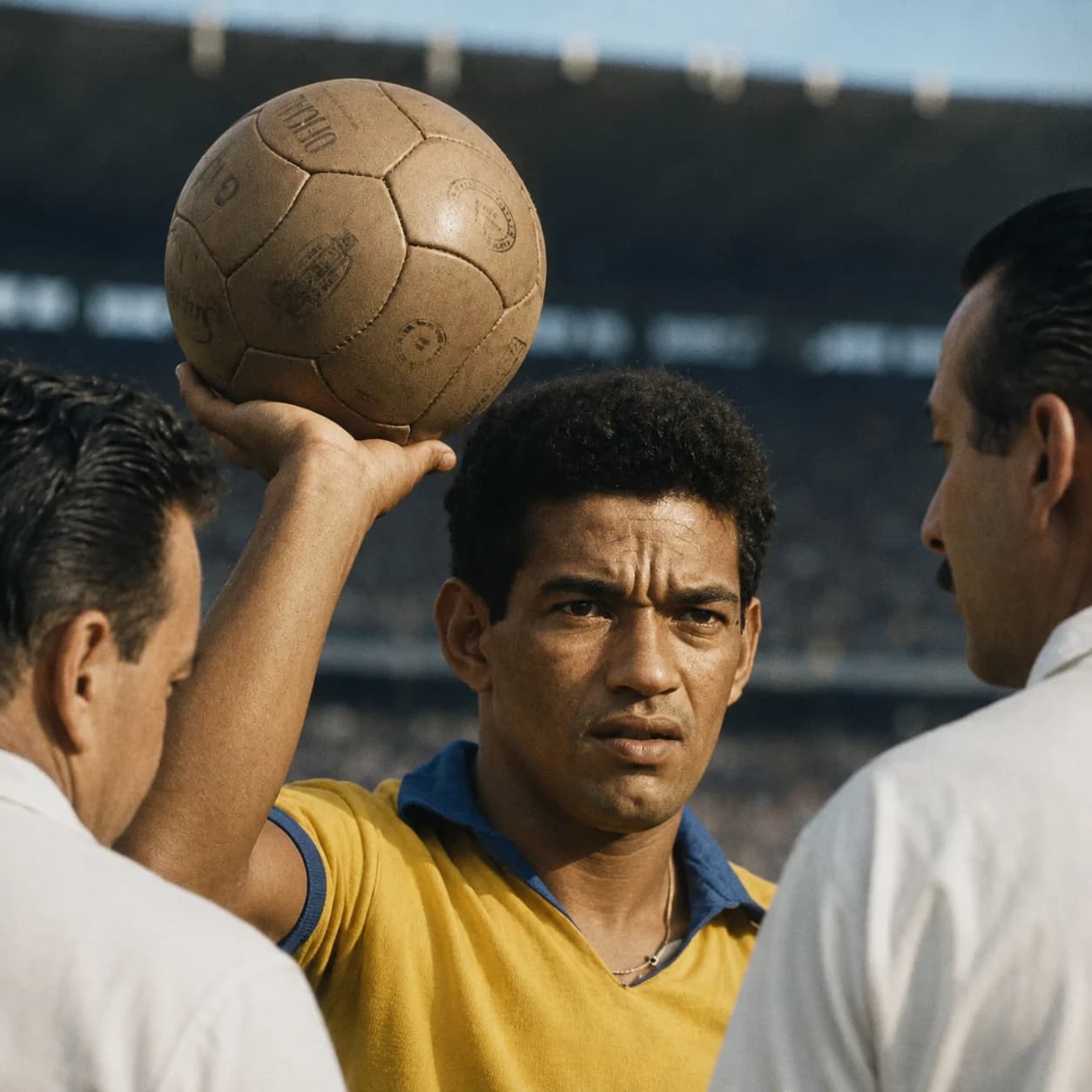
He was born with crooked legs and told he might never walk properly. He became the most unplayable dribbler football has ever seen — the man who won Brazil a World Cup almost on his own. Then the same life that handed a poor factory town a genius took everything back.
Garrincha: The Joy and the Ruin of Brazil's Bent-Legged Genius
He was born with legs that pointed the wrong way. The left one bowed inward, the right one bowed outward, and one was shorter than the other — accounts differ on which, and by how much, but everyone agrees the boy came out of the womb looking like he'd been assembled from spare parts. A doctor is said to have warned that he might struggle to walk normally.
He became the most unplayable dribbler the sport has ever produced. A man who won a World Cup for Brazil almost by himself. And the same crooked, improbable life that handed a poor factory town a genius spent the next thirty years taking it all back.
The Bird
Manuel Francisco dos Santos was born on 28 October 1933 in Pau Grande, a company town in the hills above Rio de Janeiro built around the América Fabril textile mill. Everyone in Pau Grande worked for the mill, or was going to. The boy was expected to, eventually.
He didn't much care for the plan. He hunted birds in the forest, swam in the river, chased girls, and by his teens had a serious appetite for cachaça — the sugarcane spirit that would follow him to the end. One of his sisters, watching him dart about, nicknamed him after a scruffy little forest bird: garrincha, a wren. It stuck harder than his given name ever would.
The legs that should have crippled him did the opposite. His centre of gravity was somewhere no defender could predict. When he moved, his body sent one signal and his feet delivered another, and there was no coaching manual for a shape like his. He wasn't fast in a straight line. He didn't need to be.
The Trial
In 1953 he was taken to Botafogo, one of Rio's big clubs, for a look. The story that gets told — and it has been told so many times that the edges have worn smooth — is that they put him up against Nílton Santos, the club's seasoned left-back and a Brazil international who would go on to win two World Cups. A test: let the experienced man deal with the strange boy from the sticks.
Garrincha, the legend goes, embarrassed him. Nutmegged him, went past him, came back and did it again. And Nílton Santos, rather than sulk, walked off and told the club to sign the boy immediately — because if Botafogo didn't, some opponent would, and then Nílton would have to face this every week.
Whether it happened quite so cleanly, nobody can now be certain. What is certain is that Botafogo signed him, and that within a couple of seasons the wren from Pau Grande was the most talked-about winger in Brazil.
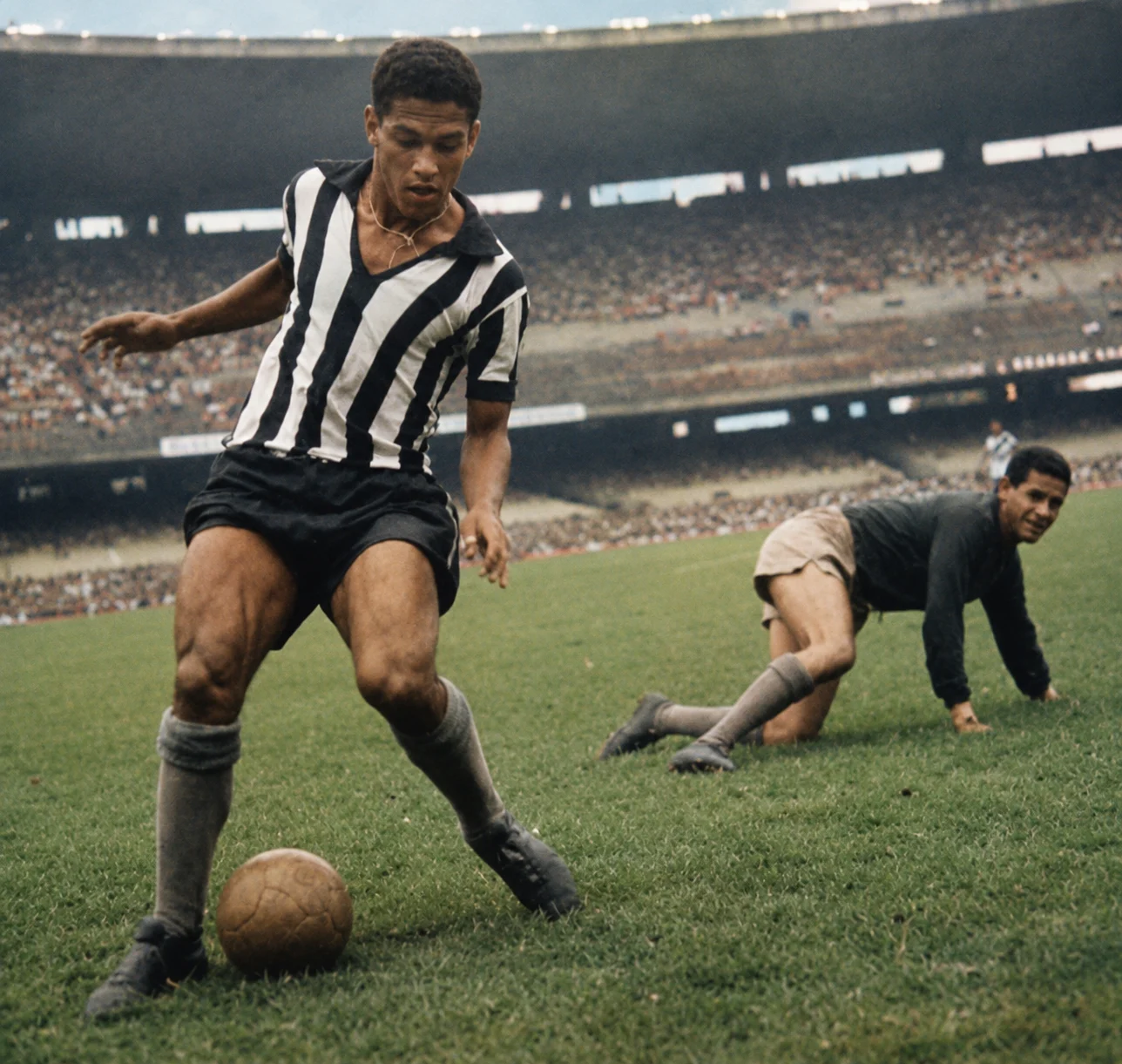 Garrincha in the Botafogo shirt – the winger nobody could plan for
The Dribble
Here is the strange part. His trick was not a secret.
Garrincha would take the ball to the touchline, drop his shoulder, feint as if to cut inside, and then go outside to the right. That was it. That was the move. Full-backs knew it was coming. Their managers told them it was coming. Entire stadiums, tens of thousands of people, knew exactly what he was about to do.
They still couldn't stop it. The feint was so total, so committed by the whole crooked architecture of his body, that grown professionals bought it every single time. He would beat a man, and then — this is the detail that says everything about him — he would sometimes wait for the defender to get back up, and beat him again. Not for the scoreline. For the crowd. For the pleasure of it.
He played like the pick-up games in Pau Grande had never ended. There is a 1963 documentary about him with a title that doubles as an epitaph: Alegria do Povo — "Joy of the People." That was the thing he was. Not the best player in the world, necessarily. The most joyful.
The Boy and the Bird
At the 1958 World Cup in Sweden, Brazil arrived carrying two of the most gifted attackers the game would ever see, and started the tournament with neither of them in the side. Garrincha was considered undisciplined. The other one, a seventeen-year-old named Pelé, was considered too young and was carrying a knock.
The details of how they got in are murky — some accounts credit a delegation of senior players who told the coaching staff, in effect, that the team was better with the boy and the bird than without them. By the quarter-finals both were playing. Brazil won their first World Cup. Garrincha tormented the Soviet Union's full-backs in the group stage in a performance still cited in Brazil as one of the great individual displays, and the yellow shirt suddenly had two impossible attackers instead of one.
For the next several years, a claim attached itself to the pair that Brazilians repeated like scripture: with both Garrincha and Pelé in the starting eleven, Brazil did not lose. The precise bookkeeping behind that boast has always been a little slippery. The aura behind it was not. When they both played, Brazil simply expected to win.
The One-Man World Cup
Then came Chile, 1962, and the tournament that belongs to Garrincha the way 1986 belongs to Maradona.
Pelé pulled up injured in the second match and took no further part. Brazil, defending champions, were suddenly without their young star and, on paper, in trouble. What followed was one of the greatest individual World Cups anyone has ever produced.
Against England in the quarter-final, Garrincha scored twice — one of them a header, from a man who barely cleared five foot seven, and one a swerving, dipping shot that the goalkeeper could only wave at. Against Chile, the host nation, in the semi-final, he scored twice more and Brazil won 4-2. He was, by then, doing the work of an entire forward line on his own bent legs.
He was also sent off in that semi-final, kicked and provoked all afternoon until he finally retaliated. By the ordinary rules he should have missed the final. He did not. What exactly saved him has been argued over ever since — a lenient disciplinary committee, a sympathetic referee's report, and, according to the more colourful accounts, quiet pressure from the very top of Brazilian officialdom, unwilling to contest a World Cup final without him. He played. Brazil beat Czechoslovakia 3-1. Two World Cups, back to back.
At that moment, in the middle of 1962, Manuel dos Santos was arguably the most beloved footballer alive. In Brazil, where Pelé was admired, Garrincha was loved — because he was one of them, a poor kid who played for fun and never quite grew up, and because watching him was pure happiness with no homework attached.
That was the top of the curve.
The Turn
The descent had, in truth, already begun underneath the glory.
The drinking had never stopped since Pau Grande, and now there was money and fame to fuel it. His private life was a sprawl that biographers have never fully untangled — a first marriage to a woman named Nair and a large number of children, the count usually given as around fourteen, though nobody, possibly including Garrincha, ever kept a reliable tally.
Then he met Elza Soares, one of Brazil's great samba singers, and left his family for her. The affair scandalised a conservative country and made him, for the first time, a figure of disapproval rather than pure affection. And in 1969 came the accident that seemed to bend the rest of his life for good: a car crash in which the mother of Elza Soares was killed. Garrincha, who had been drinking, survived. The guilt did not leave him, and neither did the bottle.
The Decline
The legs that had made him — the crooked, miraculous legs — began to give out. Years of impossible torque on knees that were never built straight in the first place. The dribble slowed. The body that had bought defenders with a single shoulder-drop could no longer be relied on to answer.
He drifted. After Botafogo he turned up at Corinthians, then Portuguesa, then a club in Colombia, then back to Brazil with Flamengo and, finally, Olaria — each stop smaller than the last, the crowds pulling in to see what was left of the Joy of the People and, too often, finding a heavier, sadder man. The money he had earned was gone: spent, given away, taken by people who were better with paperwork than he was. He had made a nation rich in happiness and kept almost none of it for himself.
The joy still flickered. Witnesses to those late, diminished games talk about moments when the old shape came back for a few seconds, and the whole thing was there again — the feint, the touchline, the defender left sitting down. Then it would pass, and there would be the rest of it.
The End
Garrincha died on 20 January 1983, of alcoholic cirrhosis, in a Rio hospital. He was 49. He died with almost nothing.
They took him back to Pau Grande, to the company town where the mill had expected him to spend a quiet working life, and buried him there. His headstone carries the line that had followed him since the documentary: here rests Mané Garrincha — Alegria do Povo. Years later, Brazil would name the national stadium in its capital after him — the Estádio Nacional Mané Garrincha in Brasília — a vast concrete monument to a man who ended his life unable to hold onto a house.
There is a temptation, with a story like this, to reach for a lesson. That fame is hollow, that talent is not enough, that a country will take a poor man's genius and give him a stadium instead of a pension. All of it is true and none of it quite captures him.
What captures him is simpler and harder. For about ten years, a man born with the wrong legs could make a hundred thousand people laugh with their whole bodies, could turn a football match into something closer to a party than a contest, could beat the same defender twice for no reason except that it was fun. He gave that away freely, to anyone watching, for as long as his knees would let him.
He just could never quite give any of it to himself.
Sources: Ruy Castro's definitive biography "Garrincha: The Triumph and Tragedy of Brazil's Forgotten Footballing Hero" (originally published in Portuguese as "Estrela Solitária"); Alex Bellos's "Futebol: The Brazilian Way of Life"; the 1963 documentary "Garrincha, Alegria do Povo," directed by Joaquim Pedro de Andrade; contemporary match reports from the 1958 and 1962 World Cups. Where accounts of his life conflict — and with Garrincha, they frequently do — this piece has tried to keep the legend and the record on separate sides of the line.