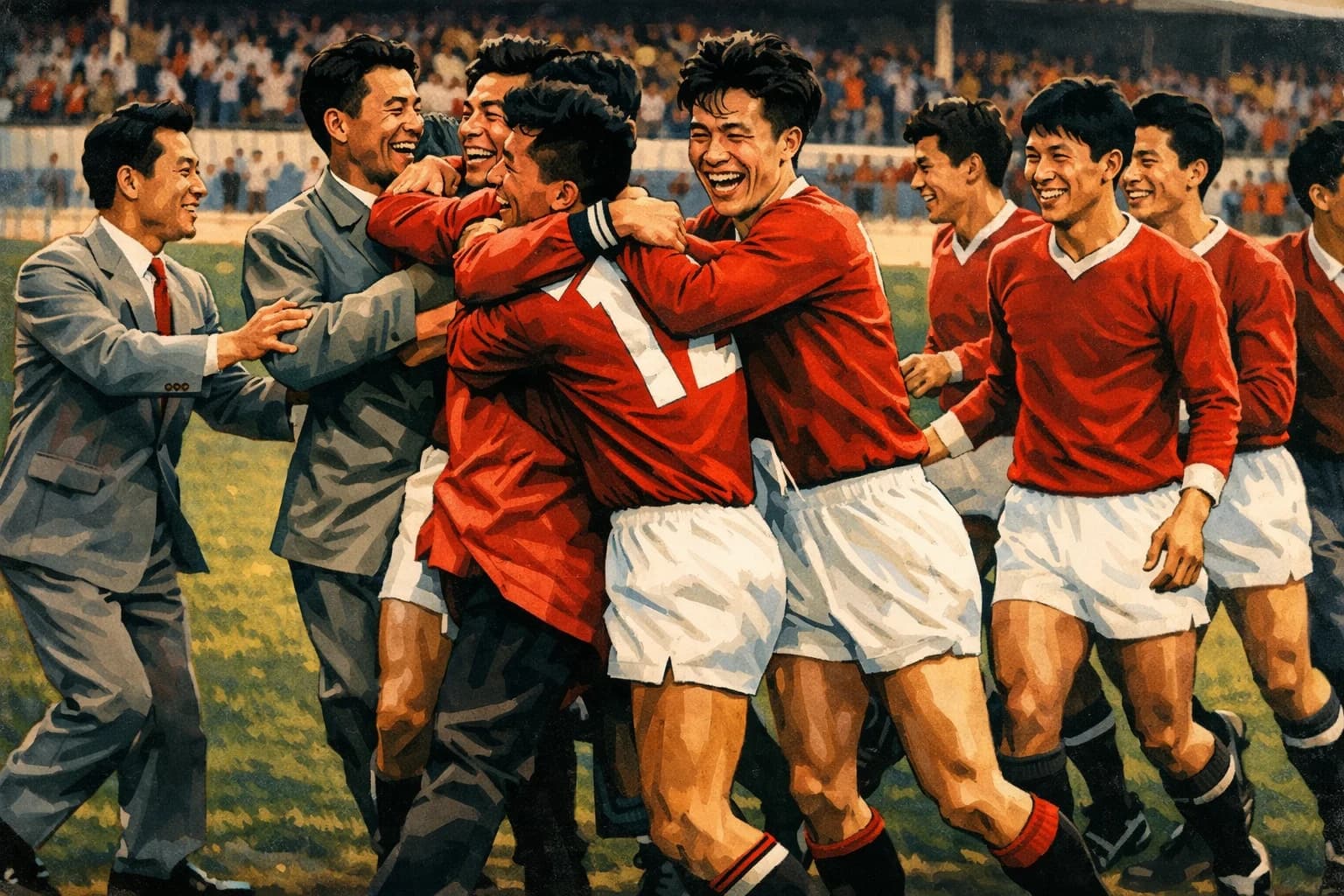
In 1966, North Korea shocked the football world by defeating Italy and nearly eliminating Portugal. Then they disappeared into history, their story becoming one of the World Cup's greatest mysteries.
The 1966 World Cup in England is remembered for many things: the host nation's triumph, Geoff Hurst's hat-trick in the final, and the controversial goal that wasn't. But perhaps the tournament's most remarkable story came from the most unexpected source – North Korea, a team that arrived as complete unknowns and left as legends, before disappearing into the shadows of history.
The Hermit Kingdom Enters the World Stage
In 1966, North Korea was one of the world's most isolated nations. The Korean War had ended just 13 years earlier, and the country had virtually no contact with the outside world. Football was not a priority in a nation focused on survival and ideology. Yet somehow, this mysterious team qualified for the World Cup, becoming the first Asian team to do so since 1954.
Their qualification itself was controversial. They finished top of their Asian group, but South Korea refused to play them for political reasons. FIFA's solution was to send them to a playoff against Australia. North Korea won 9-2 on aggregate, earning their ticket to England. The football world barely noticed. After all, what could a team from one of the world's poorest, most isolated countries possibly achieve against Europe's elite?
Arrival in England: The Underdogs Nobody Wanted
When North Korea arrived in England, they were housed in Middlesbrough, far from London's spotlight. This was partly logistical and partly political – FIFA wasn't sure how to handle a team from such a controversial nation. The players stayed at a local hotel, trained at local facilities, and were kept largely out of the media's view.
But something unexpected happened: the people of Middlesbrough fell in love with them. The North Korean players were polite, humble, and clearly thrilled to be there. They waved to crowds, signed autographs, and showed genuine joy at experiencing the world beyond their borders. Local fans, initially curious, became supporters. When North Korea played their group matches at Ayresome Park, Middlesbrough's stadium, thousands of locals turned up to cheer for the underdogs.
The Group Stage: Respect Earned
North Korea's first match was against the Soviet Union, one of the tournament favorites. Nobody expected them to compete, let alone win. They lost 3-0, but the scoreline was misleading. North Korea played with discipline, organization, and fearlessness. They weren't there to make up the numbers – they were there to compete.
Their second match, against Chile, ended 1-1. North Korea took the lead through Pak Seung-jin before Chile equalized. It was an impressive result, and suddenly people started paying attention. Could this team actually advance from their group?
The Miracle: North Korea 1-0 Italy
The final group match was against Italy, a two-time World Cup winner and one of football's great powers. Italy needed only a draw to advance. North Korea needed a win. Nobody gave them a chance.
What happened next shocked the football world. In the 42nd minute, Pak Doo-ik, a corporal in the Korean People's Army and part-time footballer who worked as a dental technician, received the ball just outside the penalty area. He took a touch, looked up, and struck a shot that flew past Italian goalkeeper Enrico Albertosi and into the net.
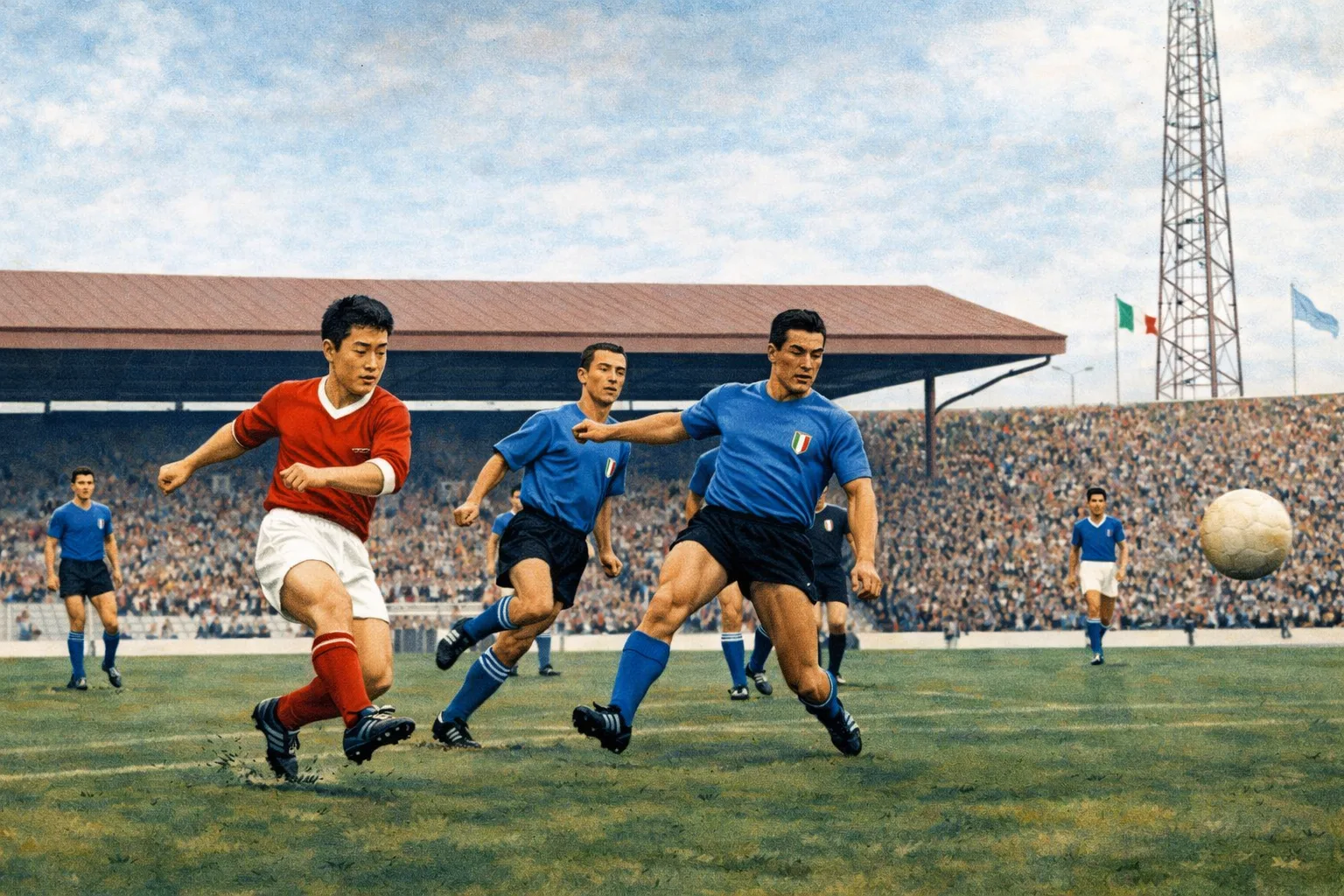 Pak Doo-ik striking the goal that shocked the world
Ayresome Park erupted. The 17,000 fans, most of them locals who had adopted North Korea as their team, roared in celebration. Italy pushed desperately for an equalizer, but North Korea's defense held firm. When the final whistle blew, one of the biggest upsets in World Cup history was complete. Italy, the giants of world football, were eliminated by a team of part-time players from one of the world's most isolated nations.
The Quarterfinal: So Close to Glory
North Korea's reward for beating Italy was a quarterfinal against Portugal, led by the great Eusebio. Once again, they were massive underdogs. And once again, they shocked everyone.
Within the first 25 minutes, North Korea led 3-0. Goals from Pak Seung-zin, Li Dong-woon, and Yang Seung-kook had put them in complete control. The impossible was happening again – North Korea was on the verge of reaching the World Cup semifinals.
But then Eusebio took over. The Portuguese legend, humiliated and angry, dragged his team back into the game. He scored four goals, two from the penalty spot, as Portugal fought back to win 5-3. It was one of the greatest individual performances in World Cup history, but it took nothing away from North Korea's achievement. They had led Portugal 3-0 in a World Cup quarterfinal. They had shown the world that they belonged.
The Return Home: Heroes or Prisoners?
After the tournament, North Korea returned home to a hero's welcome. Or did they? This is where the story gets murky. For decades, rumors circulated about what happened to the players. Some claimed they were sent to labor camps for losing to Portugal. Others said they were punished for becoming too popular and enjoying Western life too much. The truth remained hidden behind North Korea's closed borders.
In 2002, a British filmmaker named Daniel Gordon tracked down the surviving members of the 1966 team. What he discovered was surprising: most of the players had lived normal lives after the tournament. They returned to their jobs – some in the military, others as workers – and were celebrated as national heroes. Pak Doo-ik, the man who scored against Italy, continued working as a gymnastics instructor.
The players spoke fondly of their time in England, particularly the warmth they received from Middlesbrough fans. They remembered the atmosphere, the excitement, and the feeling of competing on football's biggest stage. They expressed regret at losing to Portugal but pride in what they had achieved.
The Legacy: Middlesbrough's Korean Heroes
In Middlesbrough, the memory of North Korea's 1966 team never faded. In 2002, when Daniel Gordon's documentary "The Game of Their Lives" was released, it reignited interest in the story. A delegation from Middlesbrough traveled to North Korea in 2002 and again in 2015 to meet the surviving players and present them with medals commemorating their achievement.
Pak Doo-ik, now in his 80s, remains a legend in both North Korea and Middlesbrough. His goal against Italy is still celebrated as one of the greatest World Cup upsets. A plaque at the Riverside Stadium (which replaced Ayresome Park) commemorates North Korea's remarkable run.
What Made Them Special?
North Korea's success in 1966 wasn't just luck. Their coach, Myung Rye-hyun, had instilled a disciplined, organized system based on fitness, teamwork, and tactical awareness. The players were incredibly fit – they could run for 90 minutes without tiring, a significant advantage in an era when fitness standards were lower than today.
They also played without fear. Having nothing to lose and everything to prove, they approached every match as an opportunity rather than a burden. Their humility and work ethic won them friends everywhere they went, and their tactical discipline frustrated better-resourced opponents.
The Bitter Reality of Isolation
North Korea has never returned to the World Cup since 1966. They qualified in 2010 but were eliminated in the group stage, losing all three matches. The 1966 team remains their greatest footballing achievement, a brief moment when the hermit kingdom opened its doors and showed the world what it could do.
The tragedy is that North Korea's isolation has prevented football from developing in the country. While Asian football has grown dramatically since 1966, with Japan, South Korea, and others becoming competitive forces, North Korea remains frozen in time. The potential shown by the 1966 team was never built upon, and the players who created that magic faded into obscurity.
A Story That Transcends Football
The story of North Korea at the 1966 World Cup is about more than football. It's about human connection transcending politics, about underdogs defying expectations, and about how sport can bring people together even in the darkest of times. The bond between Middlesbrough and the North Korean team endures nearly 60 years later, a reminder that football's greatest moments often come from the most unexpected places.
Pak Doo-ik's goal against Italy remains one of the World Cup's most iconic moments. The image of North Korean players celebrating on the Ayresome Park pitch, embraced by English fans, is a powerful reminder of football's ability to create moments of pure joy regardless of politics or borders.
The 1966 North Korean team proved that in football, anything is possible. They showed that heart, discipline, and teamwork can overcome superior resources and reputations. And they created a story that, despite decades of trying, the world has never been able to forget.