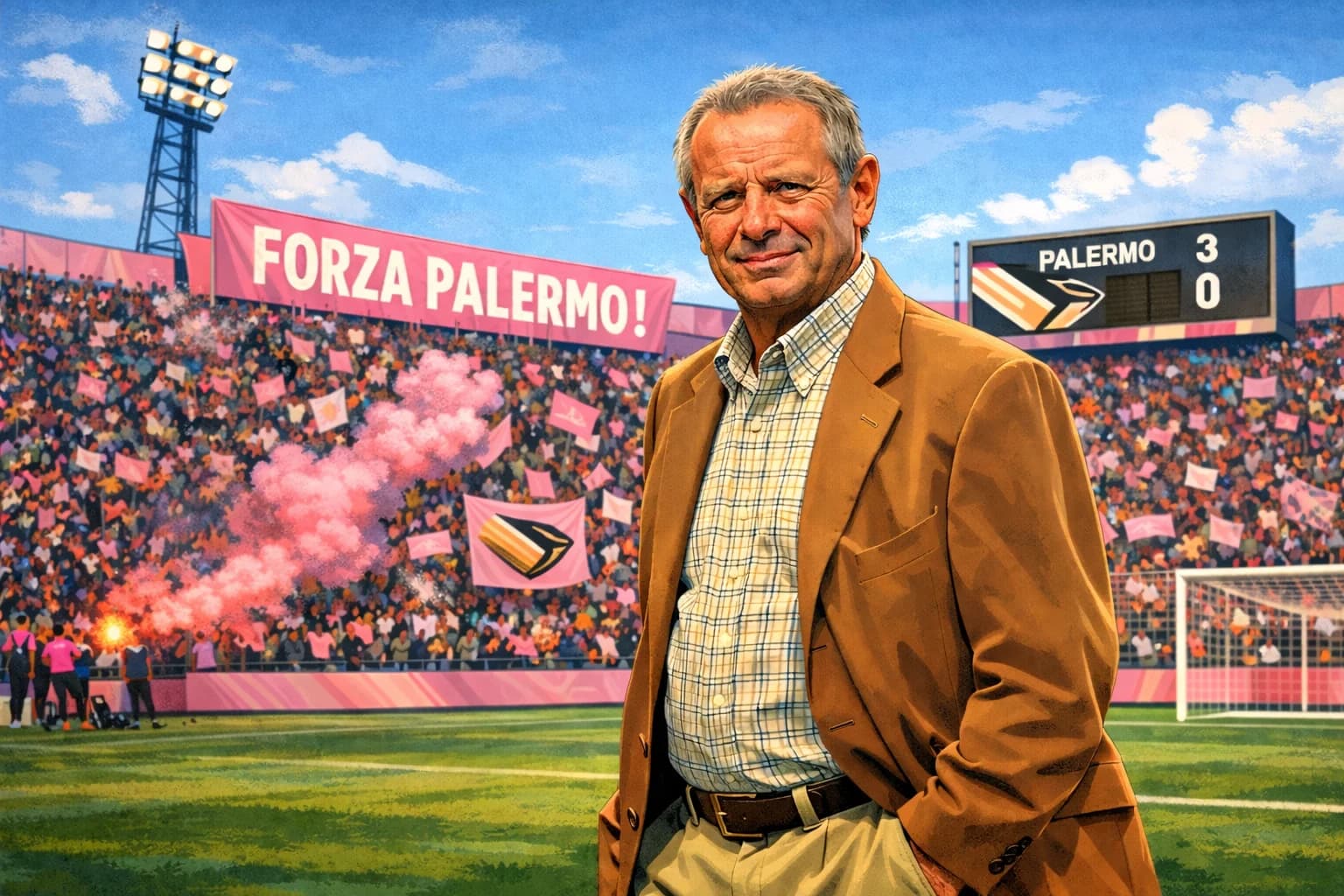
Maurizio Zamparini's reign at Palermo was defined by one thing: firing coaches. In his most chaotic season, he appointed 11 different managers, creating a circus that became Italian football folklore.
In the world of football ownership, there are visionaries, there are businessmen, and then there's Maurizio Zamparini. The Italian businessman who owned Palermo from 2002 to 2017 became legendary not for trophies or financial success, but for something far more chaotic: his inability to keep a coach employed for more than a few weeks. While most owners give managers time to build their projects, Zamparini operated on a different philosophy – if things weren't perfect immediately, the coach had to go. And in one remarkable season, this philosophy reached its peak absurdity: 11 different coaches in a single campaign.
The Man Behind the Madness
Maurizio Zamparini made his fortune in the fashion industry before entering football. In 1987, he bought Venezia, a club in Serie C1, and immediately began his pattern of hiring and firing coaches at an alarming rate. During his 15 years at Venezia, he went through 30 different managers. When he sold the club and purchased Palermo in 2002, many thought he might have learned his lesson. They were wrong.
Zamparini arrived at Palermo with grand ambitions. The Sicilian club had been stuck in Serie B for decades, but the new owner promised to take them to the top flight and beyond. To be fair, he delivered on the first part – Palermo reached Serie A in 2004. But the methods he used to get there, and the chaos that followed, would make his time at Venezia look stable by comparison.
The Philosophy of Panic
Zamparini's approach to management was simple: immediate results or immediate dismissal. He didn't believe in patience, rebuilding, or giving coaches time to implement their ideas. A two-game losing streak? Fire the coach. A bad performance, even in a win? Fire the coach. A coach he simply didn't like the look of anymore? Fire the coach.
His justification was always the same: he was passionate about winning and couldn't stand mediocrity. "I want to win, and if a coach can't deliver, I need to find someone who can," he would say. The problem was that no coach could deliver under such conditions. The constant turnover meant no tactical consistency, no team cohesion, and players who never knew who would be in charge next week.
The Record-Breaking Season: 2013-14
While Zamparini had always been trigger-happy, the 2013-14 season was something special. It was the season where his coaching carousel reached its peak, a masterclass in administrative chaos that saw 11 different men sit in the Palermo dugout over the course of nine months.
The Coaches Who Came and Went
The season started with Giuseppe Sannino in charge. He lasted until September when he was replaced by Gian Piero Gasperini after just four games. Gasperini, a respected coach who would later find great success at Atalanta, managed six matches before he too was shown the door in November.
Next came Alberto Malesani, who survived seven games before being sacked in December. Then came Bortolo Mutti for three games, followed by Giuseppe Iachini for seven games. By March, Zamparini had already gone through five coaches, but he was just getting started.
Davide Ballardini came next but lasted only two games before being replaced by... Iachini again. Yes, Zamparini brought back a coach he had fired just weeks earlier. This second stint lasted four games before Iachini was fired for the second time. Then came Gennaro Gattuso for five games, followed by Giovanni Bosi for one game, and finally, Beppe Iachini returned for a third time to finish the season.
That's right – Iachini was hired, fired, rehired, fired again, and hired a third time all in the same season. It would be comedy if it weren't so absurd.
The Impact on Players and Performance
Unsurprisingly, this chaos had consequences. Players never knew what system they would be playing or what the coach's philosophy would be from week to week. Some coaches preferred attacking football, others defensive. Some wanted high pressing, others wanted to sit deep. The constant changes made it impossible for the team to develop any identity or consistency.
Despite the madness, Palermo somehow avoided relegation that season, finishing 15th. It was a testament to the quality of players like Paulo Dybala, Franco Vázquez, and Andrea Barzagli, who managed to perform despite the circus around them. Many of these players would later admit that the constant coaching changes made that season one of the most difficult of their careers.
The Zamparini Legacy
Over his 15 years at Palermo, Zamparini hired and fired 40 different coaches. That's an average of nearly three coaches per season. Some lasted months, others just days. The record-breaking 2013-14 season was the peak, but it was hardly an outlier – it was simply the most extreme example of how Zamparini operated.
Despite the chaos, there were good times. Palermo qualified for the UEFA Cup in 2005-06 and reached the Coppa Italia final in 2011. They also developed talented players who went on to bigger clubs, with Zamparini's scouting network proving to be one of the few things he got consistently right.
But the coaching carousel eventually took its toll. In 2017, Palermo was relegated to Serie B, and financial problems forced Zamparini to sell the club. Just two years later, Palermo went bankrupt and dropped to Serie D, a stunning fall for a club that had spent over a decade in Italy's top flight.
The Aftermath
Zamparini's legacy is complicated. On one hand, he brought investment, ambition, and excitement to Palermo. On the other hand, his obsessive need for immediate results and his inability to show patience created an environment where sustained success was impossible. The 2013-14 season stands as a monument to his madness – a world record that will likely never be broken and one that most clubs would never want to attempt.
Today, Palermo is slowly rebuilding in Serie B, having reformed after bankruptcy. Zamparini, now in his 80s, has stepped away from football. But his circus, particularly that incredible season with 11 coaches, remains one of the most bizarre chapters in Italian football history. It's a reminder that in football, stability often matters more than ambition, and that sometimes the best decision is to make no decision at all.
The Zamparini years at Palermo prove that you can have money, you can have talented players, and you can have ambition, but without patience and a clear plan, chaos is inevitable. And in Zamparini's case, that chaos became legendary – for all the wrong reasons.