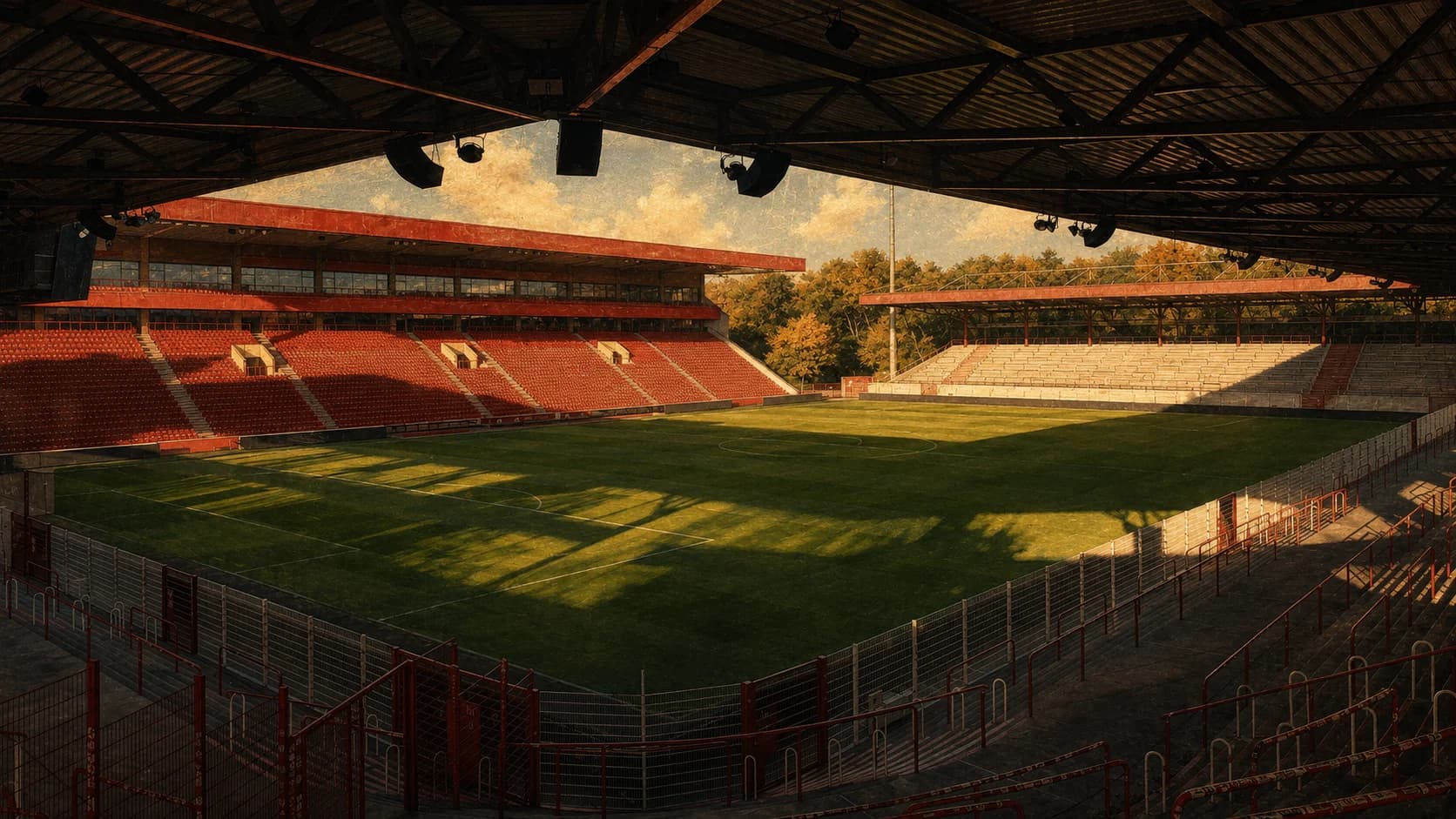
In 2004, supporters of a broke third-division club from East Berlin queued up to give blood and handed the donation money to their club. Five years later they rebuilt its stadium with their own hands. In 2023, that club walked out at the Bernabéu. This is the story of Union Berlin, football's great stubborn exception.
The Club Where Fans Gave Blood: Union Berlin's Long Walk to the Champions League
In the spring of 2004, supporters of a third-division football club from the industrial southeast of Berlin began turning up at blood donation centres in unusual numbers. They were not sick, and nobody they loved was sick. They were fans of 1. FC Union Berlin, their club was dying, and they had noticed something about German blood banks: donors receive a small expense payment for every donation.
So they gave blood, took the money, and handed it to the club.
The campaign had a name, "Bluten für Union". Bleed for Union. It was not a metaphor. The German football association wanted a financial guarantee of 1.46 million euros by the ninth of June, or there would be no licence for the third division at all, and Union would drop into the fourth tier, which for a club already gasping would have been something close to a death certificate. Even Berlin's governing mayor, Klaus Wowereit, turned up at the launch to back the drive, buying a donor T-shirt and, by the club's own account, telling people exactly how they could help: with a blood donation, the expense money going to the club.
Nineteen years later, this same club walked out of the tunnel at the Santiago Bernabéu to play Real Madrid in the Champions League.
Almost nothing in modern football connects those two sentences. At Union Berlin, everything does.
Iron in the Blood
The club comes from Oberschöneweide, a district of factories on the river Spree where Berlin's southeast turns industrial. The founding club, FC Olympia Oberschöneweide, was formed there in 1906, and its early players and supporters came out of the local metalworks. The team wore blue kits that looked like workers' overalls, and the players were nicknamed the Schlosserjungs, the metalworker boys.
Out of that came the war cry that still defines the club: "Eisern Union!" Iron Union. Tradition says it was first heard in the interwar years, reportedly in a derby against Hertha, though no document survives to prove it. That is how it goes with Union. The legend is always a little bigger than the paperwork.
The club that exists today, 1. FC Union Berlin, was formally founded on 20 January 1966, when East Germany reorganised its football and carved dedicated football clubs out of the big sports societies. On paper, Union was a creation of the state, like everything else in the GDR. What grew on its terraces was harder to plan.
The Club That Wasn't Dynamo
Across town sat BFC Dynamo, the club of the security apparatus. Erich Mielke, head of the Stasi, was the patron of the Dynamo sports association, and his football team won the East German title ten years in a row between 1979 and 1988. Archival research after reunification documented what Union fans had shouted from the terraces all along: referees favoured Dynamo, and several of those referees turned out to have been Stasi informants.
Union were the other Berlin club. The workers' club from Köpenick, backed by cable works and transformer plants rather than the secret police, forever in Dynamo's shadow and proud of it. The terraces had a saying for it, recorded in several variants: better a loser than a Stasi pig.
They were mostly losers, by the numbers. Union yo-yoed between the top division and the second, and won exactly one major trophy in the entire East German era: the FDGB-Pokal of 1968, a 2-1 final win over Carl Zeiss Jena in Halle. By the club's own telling, 42 of the 44 sports editors in the country had tipped Jena.
The romantic version of this history says Union's curve was full of dissidents, a resistance cell with a football problem. The club's own archivist, Gerald Karpa, has spent years gently deflating that. "I think the whole political question is completely over-exaggerated," he told The Berliner in 2019. Most Union fans were ordinary, loyal East German citizens who hated Dynamo, which is not the same thing as hating the state. Historians who study GDR football, like Alan McDougall in "The People's Game", describe something messier: defiance and conformity living side by side in the same stands.
Even the most famous story of all, that Union fans would greet every free-kick wall with chants of "the wall has to go", turns out to be slippery. Christian Arbeit, the club's long-time spokesman and stadium announcer, recalled hearing it as a child and added, with a smile, in remarks reported by ESPN: "Of course, they meant the set piece wall." Karpa went looking for anyone who could confirm the chant was ever a fixture and came back empty. It may have happened. Nobody can prove it did. Union's history is honest enough to survive saying so.
Broke, Repeatedly
Reunification was supposed to be the beginning. For Union it was a decade of near-death experiences.
Twice, in 1993 and 1994, Union won their division and celebrated promotion to the second tier. Twice the licence was refused over money, and the promotion went to someone else while the confetti was still being swept up. In 1997 the club was drowning again, owing millions, and thousands of supporters marched to the Brandenburg Gate to demand its survival. Out of that rescue came an unlikely gift: in 1998, the East Berlin punk icon Nina Hagen recorded the club anthem, "Eisern Union", and sang it live at the stadium in front of a few thousand die-hards in the third-tier gloom.
By December 2003 the team was bad and the mood was worse, and 89 Unioners did something small that became enormous. They slipped into the stadium, without permission, and sang Christmas carols together on the terrace. The Weihnachtssingen, the Christmas singing, has happened every year since. It now fills the ground with around 28,500 people holding candles, has been copied by clubs across Germany, and remains the best single image of what Union think a football club is for.
Five months later came the blood.
The 2004 crisis was the worst yet. Union had just fallen out of the second division and needed that 1.46 million euro guarantee to be allowed to play even in the third. The blood drive ran alongside donations, benefit events and, less romantically, sponsor contracts and loans arranged by the club's economic council. By early June the campaign had crossed a million euros, and the licence was saved. The blood itself was never the biggest line in the ledger, roughly half the money came through the businessmen, but it was never really about the ledger. It was about finding out what people will part with for a football club, and discovering the answer was: whatever they have.
That summer, one of those businessmen, a lifelong fan and building-materials logistics entrepreneur named Dirk Zingler, became club president. He was 39. He is president still.
The blood bought survival, not success. Union went down to the fourth tier anyway in 2005, on sporting merit this time, hit the lowest point in their history, and immediately climbed back out as champions.
The Stadium They Built Themselves
The Stadion An der Alten Försterei, "at the old forester's house", sits at the edge of the Wuhlheide woods in Köpenick, and by 2008 it was falling apart. Crumbling terraces, no roof to speak of, a ground that threatened the club's future in the professional leagues. Union had no money to fix it. So the fans fixed it.
Over thirteen months in 2008 and 2009, more than 2,300 volunteers put in around 140,000 hours of unpaid labour rebuilding their own stadium. Electricians, builders, students, pensioners. Specialists handled the jobs that needed certificates, everything else was done by people who would stand on the result. Some reportedly took time off work to be there. "Everyone has contributed to the stadium," one volunteer, Frank Völker, told the Iron Curtain Project years later. "I even know people who temporarily quit their jobs."
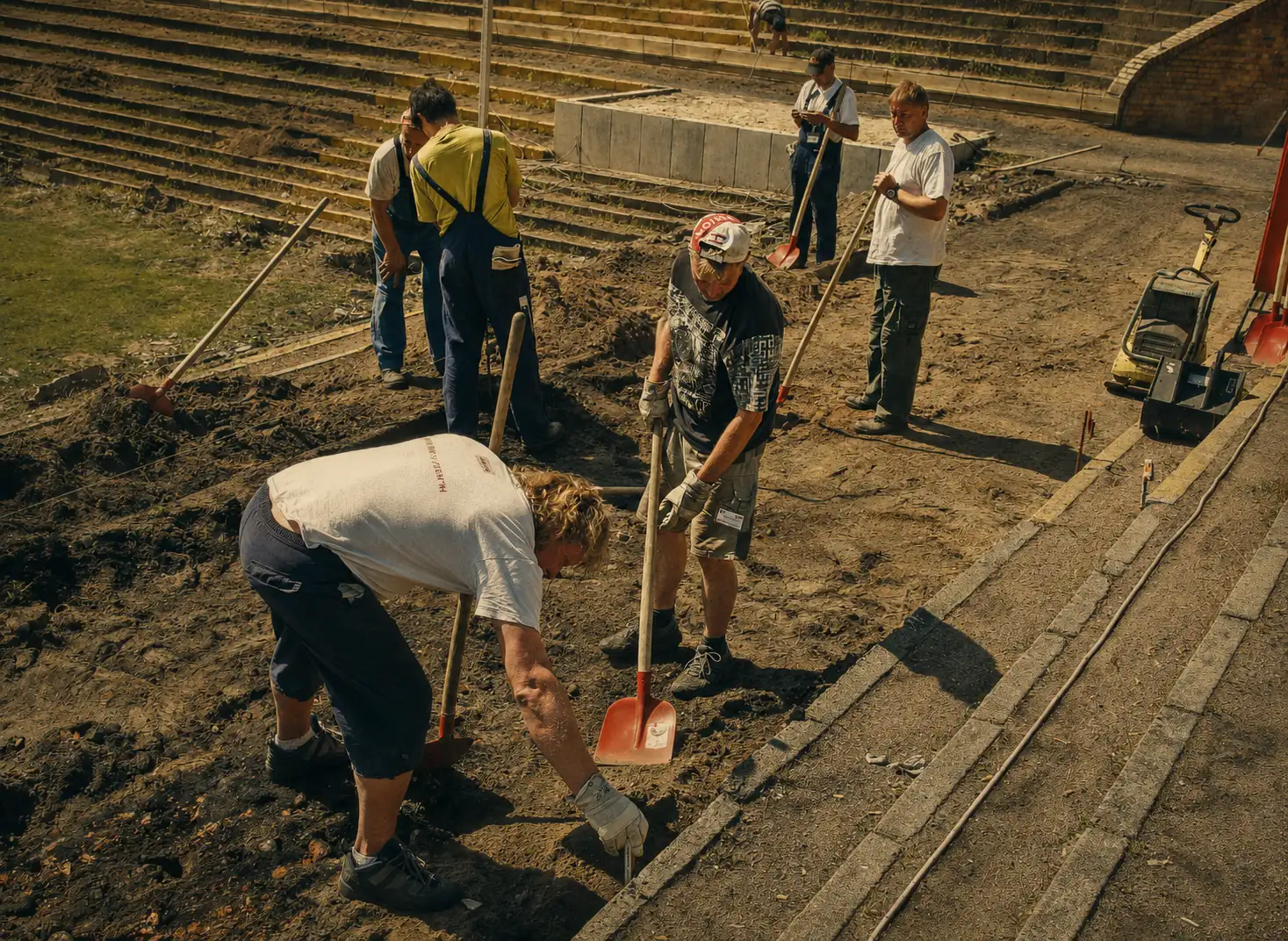 Union Berlin volunteers rebuilding the terraces of the Stadion An der Alten Försterei in 2008
The ground reopened on 8 July 2009 with a friendly against Hertha, which Union lost 5-3, a very Union way to christen a miracle. The names of the builders are stamped on iron plaques by the stadium. In 2011 the club went further and sold shares in the stadium company to its own people, thousands of members buying a piece of the ground at 500 euros a share. "The 2,500 who helped build it, the 5,000 who own shares in it, it is actually their property," Christian Arbeit told Sky Sports. The journalist Jacob Sweetman, who has covered the club for years, put it more bluntly in a separate Sky Sports feature: "The rebuilding of the stadium is not a myth. I have never seen anything like that."
The result is a Bundesliga ground of 22,012 with only 3,617 seats. Everyone else stands. Kit Holden's book on the club, the definitive one in English, is built on the same premise as the stadium: at Union, the fans are not the audience. They are the infrastructure.
Scheiße, We're Going Up
The strangest chapter starts in 2018, when Union, by now a settled second-division club, hired a quiet Swiss coach named Urs Fischer. On 27 May 2019, after a goalless second leg against VfB Stuttgart and a 2-2 aggregate that turned on away goals, Union were promoted to the Bundesliga for the first time. The pitch disappeared under bodies.
They were the first club from East Berlin ever to reach the Bundesliga, and only the sixth from the former East. And their own fans had spent years greeting the possibility with one of football's great ironic chants: "Scheiße, wir steigen auf." Shit, we're going up. It sounds like a joke and was closer to a worry. Promotion meant television money, tourists, higher prices, the machine. A former coach, Jens Keller, once said the chant made him happy because it was meant sarcastically. Holden liked it enough to make it the title of his book. The fear underneath it was entirely sincere.
What Union did with their first home match in the Bundesliga told everyone which side of that fear they stood on. The opponent, with a neatness no scriptwriter would risk, was RB Leipzig, the energy-drink club, everything Union had chosen not to become. For the first fifteen minutes the home terraces stayed silent in protest at modern football's ownership games. And along the standing ends, fans held up printed photographs of supporters who had died before ever seeing Union in the top flight, their tickets bought for them by the living. The official attendance that day was 22,467, in a stadium that holds 22,012. Union had counted the dead.
The Climb
Everyone knew how the story went from there. Newly promoted fan-owned clubs with tiny budgets fight bravely and go back down, and Germany had seen miracle seasons burn out before. Union did not go back down.
Eleventh in the first season. Seventh in the second, which meant Europe. Fifth in the third, which meant the Europa League. For a few strange autumn weeks in 2022, Union Berlin, the club that had been in the fourth tier with a hand-rebuilt stadium seventeen years earlier, sat top of the Bundesliga. Then, in May 2023, Fischer's team finished fourth and qualified for the Champions League.
"This season will be a success for us. Nobody can say otherwise," Fischer said before the decisive final matchday, and for once a coach's cliché undersold the thing completely.
A Champions League for Everyone
The Champions League immediately posed a very Union question. The Alte Försterei is mostly standing room, and rebuilding it for UEFA's requirements was not realistic on the timeline, but the deeper problem was arithmetic: 22,000 places, 56,000 members. The club chose to move its home games across the city to the Olympiastadion, Hertha's ground, with more than three times the capacity. In an open letter, Zingler's board explained the decision in one line that could serve as the club's constitution: "the Champions League is for all Unioners." Plenty of fans hated it anyway and said so on banners aimed at UEFA. Both things were true at once, which is also very Union.
The football itself was a lesson in altitude. The group contained Real Madrid, Napoli and Braga. At the Bernabéu on matchday one, Union defended for 93 minutes of their Champions League debut and lost to a Jude Bellingham goal in the 94th. They took two points from the group, both from away draws, and lost all three of their nights at the Olympiastadion. Real Madrid won all six of their games.
By then the season had already begun eating the club. Union lost twelve consecutive matches in all competitions, the worst run in their history, a slide finally stopped by a 1-1 draw away at Napoli of all places. In November 2023, Fischer and the club ended things together, by mutual agreement, with genuine sadness on both sides. The man who took Union from the second division to the Bernabéu left bottom of the table. Union stayed up on the final day of that season, and have lived in mid-table since.
Still Theirs
Gravity, in the end, was allowed to reclaim the football. It has not been allowed near anything else.
Union remain fan-owned and member-run, protected by Germany's 50+1 rule and their own bloody-mindedness, with no investor, and with season tickets so scarce the club does not even keep a waiting list for new ones. A bigger Alte Försterei is coming too, an expansion approved for the years ahead, and when the club needed capital for it in late 2024 it did what it always does: it offered shares to its own members. Even the coaching upheaval of the past year carried the club's fingerprints. When Union sacked their coach in April 2026, they handed the team to assistant Marie-Louise Eta, who became the first woman ever to take charge of a men's Bundesliga side, then won at Mainz to make that history permanent before moving, as planned, to lead the club's women's team. A new head coach, the Swiss Mauro Lustrinelli, started work this month.
An eleventh-place finish, a stadium project, a new coach. Ordinary things. It took Union Berlin a century of catastrophe to earn the right to be ordinary, and the people who paid for that right are stamped into the place itself: names on iron plaques by a terrace they built, shares in a drawer, an expense slip from a blood bank signed over to a football club a lifetime ago.
The club's cry is "Eisern Union". Iron Union. Iron is also the thing blood carries. In Köpenick, nobody needs the metaphor explained.
Sources: Kit Holden's "Scheisse! We're Going Up!: The Unexpected Rise of Berlin's Rebel Football Club" (Duckworth, 2022); Alan McDougall's "The People's Game: Football, State and Society in East Germany" (Cambridge University Press, 2014); 1. FC Union Berlin's contemporaneous statements on the 2004 "Bluten für Union" campaign and the 2023 Olympiastadion decision; Adam Bate's reporting for Sky Sports; Stephan Uersfeld and Andy Mitten's reporting for ESPN; Ingo Petz's "The State of Union" in The Point Magazine; The Berliner's 2019 interview with club archivist Gerald Karpa; the Iron Curtain Project's oral history of the stadium rebuild; Bundesliga.com and UEFA match records. Where the legend and the record disagree, and at Union they sometimes do, this piece has tried to say so.
All images in this article were generated using AI and do not depict real photographs.